Learn Glacier Travel, Ice and Mixed Climbing on the Italian Side of Mont Blanc — 5 Days
Five days of hands-on winter alpinism in the Aosta Valley: glacier skills beneath Mont Blanc, your first frozen waterfalls, mixed climbing on rock, snow and ice, a multi-pitch icefall in Cogne, and a classic alpine route to finish. Small groups, a progression that builds day by day, and UIAGM/IFMGA Mountain Guides throughout.
The Winter Mountaineering Course – Beginner is a five-day introduction to winter alpinism, taught on the Italian side of the Mont Blanc massif and in the frozen valleys of Cogne. It's built above all for people who want to become independent in the mountains: people who aim to one day plan and climb their own winter routes with a partner, and who want to learn the right way from the start. It also works for complete beginners who have never held an ice tool, and for summer hikers and climbers who want to understand how the mountains change once the temperature drops and running water turns to ice.
Each day adds a new layer to the one before. You start on the glacier beneath Mont Blanc, learning how to walk in crampons, hold an ice axe properly and move as a roped team. You then climb your first frozen waterfalls, step onto mixed ground where rock, snow and ice meet, and spend a full day on a multi-pitch icefall in Cogne. The week ends on a real alpine objective — a ridge or summit above 3,500 metres, chosen by your guide according to conditions — where everything you have learned is put to use on a route rather than practised in isolation.
The guiding ratio tightens as the climbing becomes more technical: one guide for six on the glacier day, one for four on the ice and mixed days, and one guide for two on the final two days. By the time the terrain asks more of you, you have more of your guide’s attention.
You do not need to have used crampons, ice axes or ropes before joining. Every technique on the course is taught from the ground up — first in a controlled setting, then on real terrain. What helps is a background in hiking or scrambling, a head for heights, and the fitness to stay active for six to eight hours in the cold.
Some rock climbing experience, indoors or outdoors, makes the ice and mixed days easier to absorb, but it is not a requirement. Just as valuable is the willingness to listen, try and repeat: winter climbing rewards patience and good habits more than raw strength.
Glacier travel and movement on snow — Crampon technique on flat, moderate and steep ground (flat-footing, front-pointing and combined techniques), ice axe positions and self-arrest, roping up and moving as a glacier team, and recognising crevasse hazards.
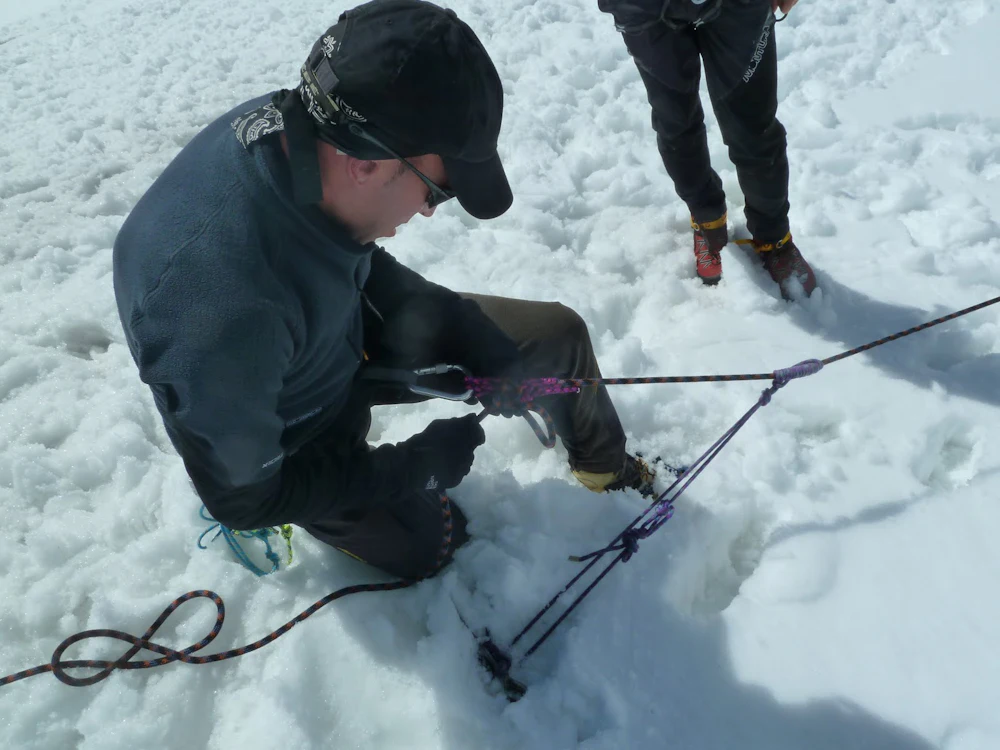
Crevasse rescue — What to do if a member of the rope team falls into a crevasse: holding the fall, building an anchor in snow (T-slot or buried axe), transferring the load and setting up a simple hauling system. You'll also practise climbing out of a crevasse on the rope using prusik loops. You'll try each step on the glacier, in a safe setting, with your guide.
Ice climbing — Efficient tool and crampon placements, body position and balance on steep ice, resting and saving energy, placing and removing ice screws, and building Abalakov (V-thread) anchors.
Mixed climbing — Hooking and torquing ice tools on rock, precise crampon footwork on granite, moving between rock, snow and ice, and placing traditional protection: nuts, cams and slings.
Rope work — Essential knots, belaying a leader and a second, stance management and changeovers on multi-pitch routes, abseiling with a friction-hitch backup, and snow anchors.
Mountain judgment — Reading weather and snow conditions, avalanche awareness and transceiver basics, choosing clothing and equipment for a winter day, and how guides decide when to go and when to turn around.
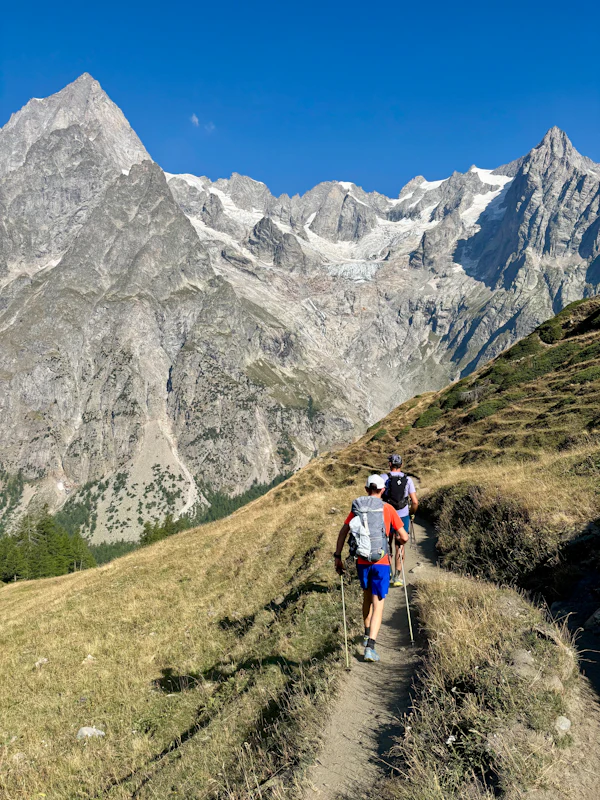
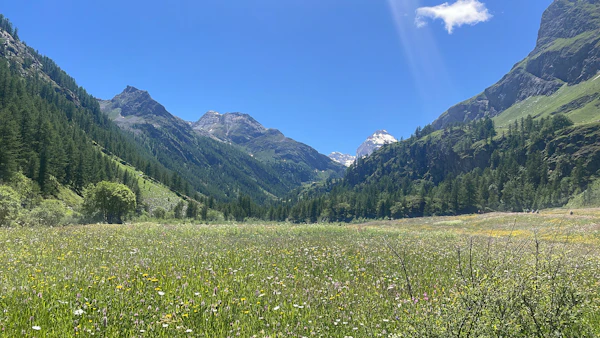
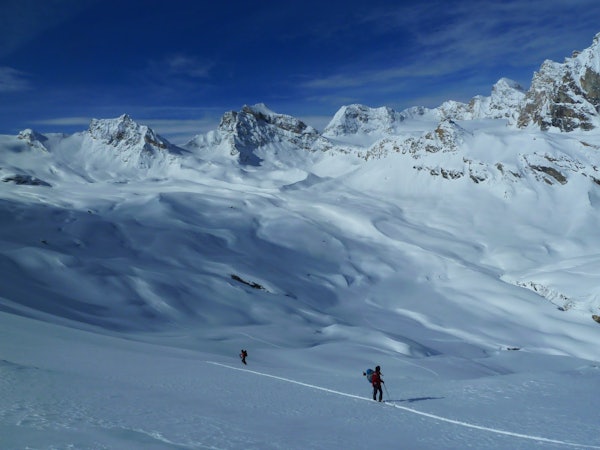
The course is based on the south side of Mont Blanc. In winter the valley is quieter than its French counterpart, the low sun lights up the Grandes Jorasses and the Dent du Géant in shades of gold and rose, and the Skyway Monte Bianco lifts you from the valley floor to Punta Helbronner (3,466 m) in a matter of minutes. From the top station you step straight into high-mountain terrain: the Glacier du Géant, the Col du Géant and a skyline of granite spires that has shaped the history of alpinism.
That access is what makes the course work. Within an hour of finishing breakfast you are on a glacier at altitude, with real terrain to learn on — crevassed slopes, steep snow, rocky ridges — and a horizon that runs from Mont Blanc to the Matterhorn and Monte Rosa. Few places in the Alps put this much winter terrain within reach of a valley hotel.
About an hour and a quarter from Courmayeur, on the northern edge of the Gran Paradiso National Park, the Cogne valley holds one of the greatest concentrations of frozen waterfalls in Europe. Well over a hundred icefalls form here each winter across the side valleys of Valnontey, Valeille and Lillaz — from short, friendly cascades ideal for a first day on ice to long, serious lines that draw climbers from all over the world.
What sets Cogne apart is reliability. Many of its routes sit around 2,000 metres in deep, shaded valleys, so the ice forms early and holds its condition through much of the winter. Approaches are short, the classic lines have well-equipped anchors, and the villages — stone houses, wood smoke, a coffee bar at the end of the road — keep the atmosphere relaxed even on busy days. The icefalls were explored systematically from the 1980s by the Italian alpinist Gian Carlo Grassi, and the valley has been a reference point for ice climbing ever since.
We have been guiding in the Aosta Valley and the Mont Blanc massif for over 20 years. Winter here is our home season: we follow how the ice is forming in Cogne, how the wind is loading the slopes around the Col du Géant, and which routes are in condition from one week to the next. This course is built on that day-to-day knowledge.
A progression, not a sampler. Many courses string together unrelated activity days. Ours is built as a sequence: the footwork you learn on the glacier on Day 1 is the footwork you use on the icefall on Day 2; the anchors you build on Day 3 are the stances you climb between on Day 4; and on Day 5 it all comes together on a genuine alpine route.
Ratios that follow the difficulty. On the glacier, a group of six learns well together. On ice and mixed terrain the group drops to four. On the multi-pitch day and the final route it is one guide for two climbers — the ratio that lets you climb longer, more interesting routes and receive close, personal coaching.
Mont Blanc and Cogne from a single base. Staying in the Aosta valley puts the high glaciers of the Mont Blanc massif minutes from your hotel and Cogne’s icefalls within easy reach. Because both areas are on our doorstep, your guide can move the programme between them to follow the best conditions rather than being tied to a single venue.
Italian mountain hospitality. Your base for the week is a welcoming hotel in the Aosta Valley, chosen for its easy access to both the Mont Blanc massif and the icefalls of Cogne. Every morning starts with a generous Italian breakfast, the kind that keeps you going through a cold day on the ice. Evenings are yours: you can enjoy the local restaurants and the valley's cooking, or go over the day's skills with your guide.
Skills you can take home. The aim is not simply to be taken up routes, but to understand them: why an anchor is built a certain way, how to read a glacier, when conditions say no. You leave with a solid foundation for further courses, guided ascents or your own first steps in winter alpinism.
Arrive and check in at your hotel, your base for the week. Take some time to settle in and look up at the peaks, with the snow already lying on the slopes above the valley.
At 6:00 p.m. you meet your guide at the hotel for the course briefing. Your guide checks your whole kit — boots, crampons, harness and clothing — makes sure your crampons fit your boots properly, and arranges anything you need to rent locally. Then you go through the week ahead: the plan for each day, how the ice is forming in Cogne, the snow conditions up high, and the forecast that will shape the first few days.
It's also the moment to ask questions, meet the rest of the group and see how a guide plans a winter week in the mountains. Dinner is at your leisure, and the valley has plenty of good restaurants serving traditional Aosta Valley food. An early night is a good idea: tomorrow you'll be on the glacier.
Meeting: 6:00 p.m. at the hotel | Overnight: hotel in the Aosta Valley (B&B)
After breakfast we drive to Entrèves, at the foot of Mont Blanc, where the Skyway Monte Bianco departs. The rotating cabins rise in two stages, first above the snowy larch forest of the valley to Pavillon (2,173 m), then on to Punta Helbronner (3,466 m). Up there the air turns cold and the valley noise is gone. From the terrace, Mont Blanc, the Dent du Géant and the Grandes Jorasses are close enough to follow their ridges line by line.
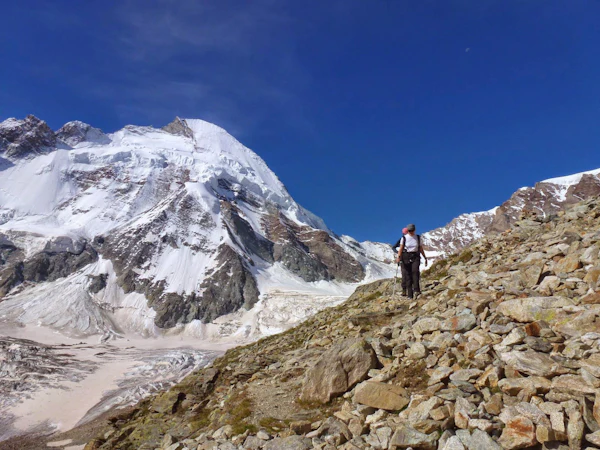
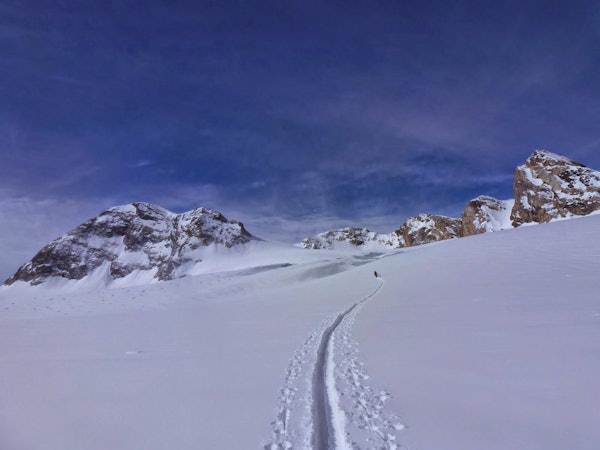
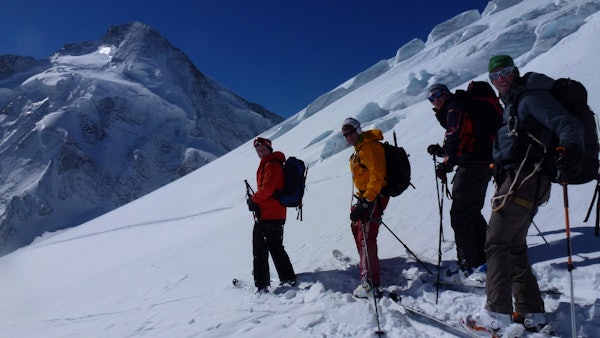
Your guide leads the group out onto the glacier plateau around the Col du Géant. The first hours go on the basics every winter route relies on: walking confidently in crampons, keeping your feet flat on moderate slopes, switching to front points as the slope steepens, and holding the ice axe in the right position for each kind of terrain. On a safe slope with a clean run-out, you practise self-arrest until you do it without thinking.
Then comes the rope. You learn how a glacier team is spaced and tied in, how to move together while keeping enough tension in the rope to hold a fall into a crevasse, and how to read the surface of the glacier. Faint sagging lines and changes in the snow's texture can give away a hidden crevasse. The day ends with crevasse rescue: building a snow anchor, holding a fall and setting up a simple hauling system. By the end you know not only how to move on a glacier, but also what to do if something goes wrong.
It's a full day at altitude and a first chance to see how your body copes with height. In the afternoon you ride back down to the valley for a hot shower and a well-earned dinner.
Altitude: 3,466 m | Guide ratio: 1:6 | Activity: approx. 5–6 hours on the glacier | Transfer: [X min] by car to the Skyway
Today is your introduction to technical ice. Your guide chooses the venue according to the week’s conditions — often the icefalls of the Cogne valleys, or quieter frozen cascades in other side valleys of the Aosta region — looking for short, well-formed routes where beginners can climb lap after lap on a top rope.
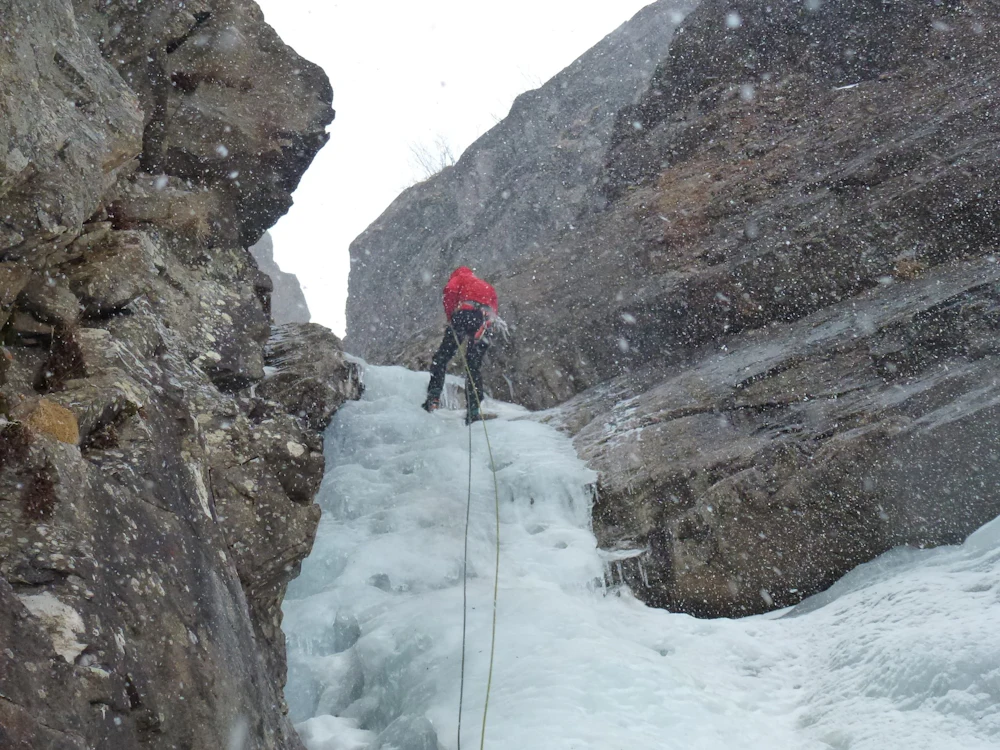
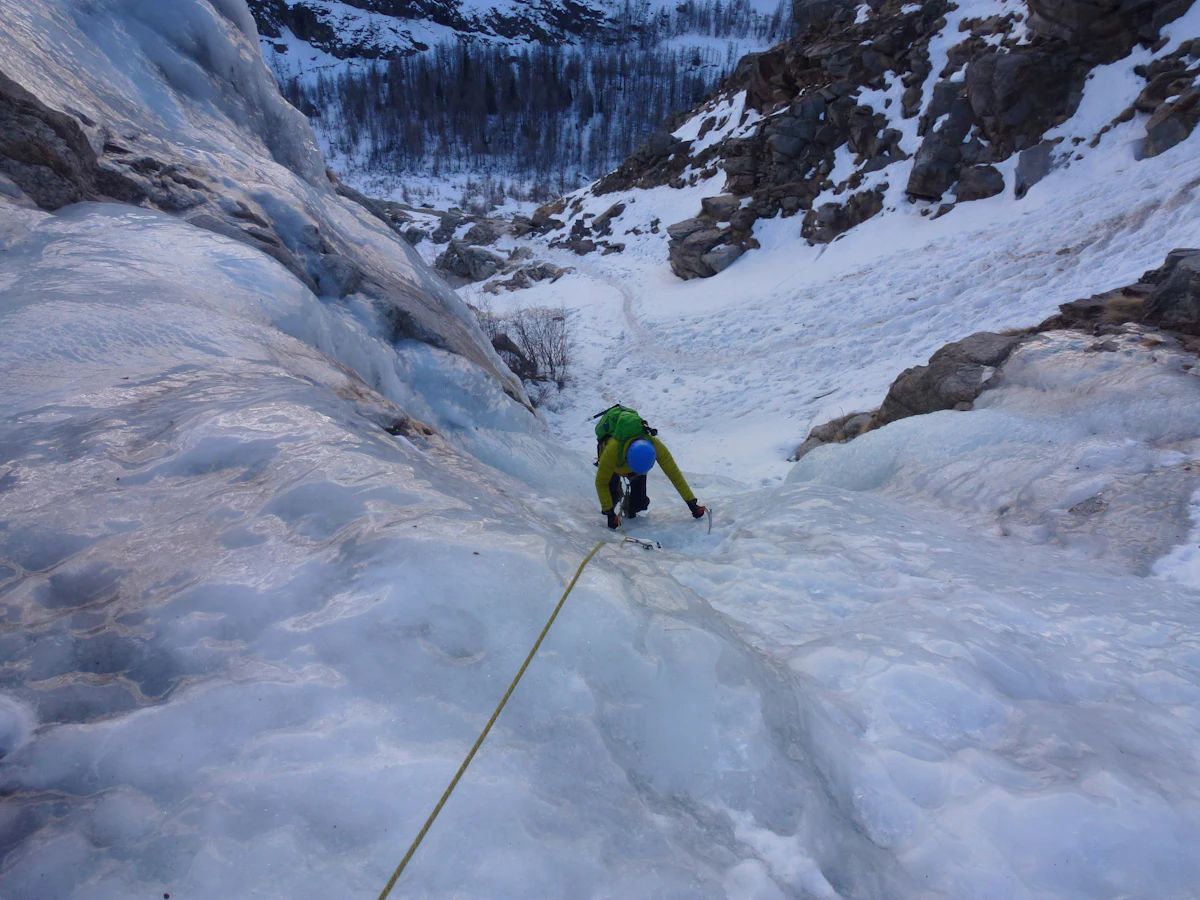
The technique comes in layers. First the feet: kicking the front points of your crampons into the ice with a relaxed, precise movement, and learning to trust them. Then the tools: a smooth swing from the shoulder, letting the weight of the axe do the work, and a placement solid enough to hang from. Then the rhythm that links them — tools, feet, stand up, repeat — and the body position that keeps your weight over your feet instead of on your arms. It sounds simple. The first time a well-placed pick sinks into blue ice with a deep, solid thud, you understand why so many people fall for this.
Between climbs you learn to belay your partners, how ice screws are placed and removed, and how to build an Abalakov thread — a V-shaped tunnel bored through the ice that forms the standard abseil anchor on icefalls. By the end of the day, most participants are climbing steeper sections with far less effort than they did in the morning.
Guide ratio: max 1:4 | Activity: approx. 5–6 hours on the ice
Mixed climbing is where winter mountaineering shows its real character: crampons on rock, ice tools hooked over edges and locked into cracks, and constant changes between snow, ice and rock. You meet this kind of terrain on almost every winter alpine route, and today is all about it.
The Aosta Valley has several crags equipped for mixed climbing and dry-tooling, many of them a short walk from the road. Your guide picks the one with the best conditions for the day. Bolted routes and well-placed anchors let you concentrate fully on technique, so you can repeat the moves as many times as you need without worrying about the terrain. You learn to trust a pick hooked on a small rock edge, to twist a tool into a crack until it locks, and to place your front points precisely on small holds instead of scraping for grip.
The rope work also goes up a level. Your guide shows you how to protect mixed ground, with nuts, cams and slings on rock and screws in the ice, and how to organise a stance so the team moves efficiently. You practise abseiling with a backup. These are the skills that turn a series of climbing moves into safe, controlled progress, and tomorrow on the multi-pitch icefalls of Cogne you'll use them for real.
From today the ratio drops to one guide for two climbers, and the routes grow longer. After breakfast you drive to Cogne and continue to the trailheads of Lillaz, Valeille or Valnontey. The approach is short, along a snowy valley floor lined on both sides with frozen falls — blue, white, sometimes almost green — hanging from the cliffs in pillars and curtains.
Your guide selects a multi-pitch route suited to the pair and to the day’s conditions: typically a moderate classic of several pitches, where the ice is steep enough to be absorbing and the stances comfortable enough to learn at. Now the climbing is for real. Your guide leads each pitch; you follow, removing the ice screws as you climb, arriving at the stance, clipping in and managing the rope for the next pitch. With two climbers per guide the pace is steady and the coaching continuous. Where a participant is ready, the guide may offer the chance to lead a short, easy section under close supervision.
From the top, the valley falls away beneath you and the peaks of the Gran Paradiso range rise above. The descent is by abseil, from the same kind of anchors you learned to build on Day 2. Afterwards there is time for a coffee in the village before the drive back to the hotel — and a long look at the bigger lines you might return for one day.
Guide ratio: max 1:2 | Activity: approx. 6–7 hour
The last day brings everything together on a real alpine objective. Your guide chooses the route according to the forecast, the snow conditions and the progress of each rope team. The main options:
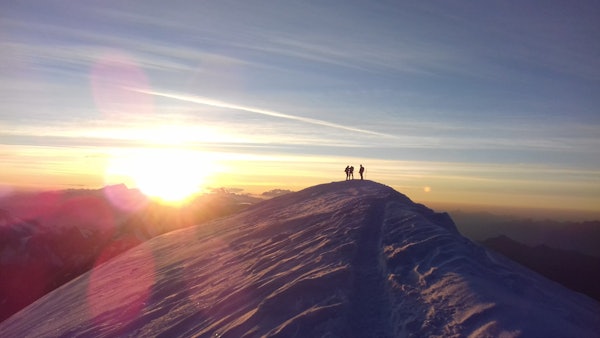
Aiguilles Marbrées (3,535 m). From Punta Helbronner, a short glacier approach leads to the foot of this ridge rising from the Glacier du Géant. The traverse links snow crests, ice and rock steps in airy positions, with the Dent du Géant and the Italian side of Mont Blanc as a constant backdrop.
Aiguille de Toula (3,538 m). Also reached from Punta Helbronner, this fine summit above the Col du Géant combines glacier travel with a mixed finish, and looks straight down to Courmayeur and the Val Veny.
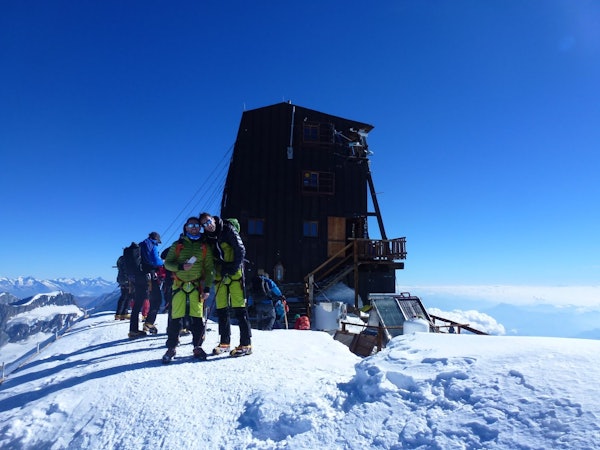
Cosmiques Ridge. A short drive through the Mont Blanc Tunnel brings you to Chamonix and the Aiguille du Midi cable car. From the top station you descend to the glacier beneath the south face and past the Cosmiques Hut, then climb back up the ridge over granite towers, snow crests and short mixed steps — finishing, fittingly, on the terrace of the Aiguille du Midi.
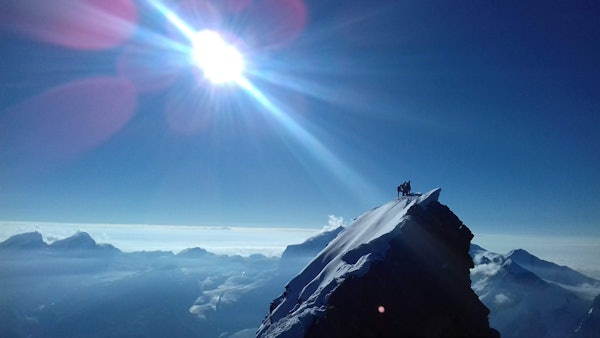
Whichever route you climb, this is a day of genuine alpine climbing: moving together on easy ground, pitching the steeper sections, abseiling where needed, and choosing footwork and tool placements on terrain that changes every few metres. With one guide for two climbers, you are an active part of the rope team, not a passenger.
The course ends in the afternoon once you are back in the valley. Your guide takes time for a debrief — what went well, what to work on, and which courses or climbs would make a natural next step. If you would like to stay an extra night at the hotel, just let us know in the booking form.
Altitude: approx. 3,500–3,840 m | Guide ratio: max 1:2 | Activity: approx. 5–6 hours | End of course: early afternoon
The Winter Mountaineering Course – Beginner is designed for newcomers to winter climbing, but it is an active and physically demanding week. Days are spent outdoors in the cold, often at altitude, with sustained effort on steep ground.
Fitness. You should be comfortable with 6–8 hours of activity per day on five consecutive days, including uphill walking in snow and repeated climbing efforts. The fitter you are, the more energy you will have for learning — and the more climbing you will do.
Mountain experience. Hiking experience in mountain terrain is expected. You should be at ease on steep, rocky paths and comfortable with exposure. Scrambling or rock climbing experience is helpful but not required.
Cold and altitude. Winter days can be cold and windy, and Days 1, 3 and 5 are spent between 3,400 and 3,850 metres. Good layering, warm gloves and a positive attitude to the conditions make a real difference.
No previous mountaineering experience required. Your UIAGM/IFMGA guide teaches every technique from the beginning — crampons, ice axes, ropes, anchors and abseiling.
We recommend preparing with regular endurance training in the months before the course: uphill hiking with a pack, running, cycling or any sustained cardio. Core, shoulder and grip strength are particularly useful for ice climbing, and a few sessions at a climbing wall will make the technical days easier.
If you are unsure whether your fitness or experience is sufficient, please get in touch. We are happy to talk through your background and help you assess your readiness.
It's a 5-day course, plus an arrival evening, based in the Aosta Valley. Over five days, each building on the last, you learn glacier travel and crampon technique on the south side of Mont Blanc, then ice climbing and mixed climbing. You go on to multi-pitch ice climbing in Cogne and finish on a classic alpine route. UIAGM/IFMGA certified Mountain Guides lead the whole course.
Basing the course in the Aosta Valley rather than Chamonix has real advantages. The valley is quieter in winter, with fewer queues at the lifts and more space on the crags. It sits at the foot of Mont Blanc's south side, a wild and less-crowded face of the massif, and it's also much closer to Cogne, one of the world's most famous ice climbing destinations. And at the end of each day there's Italian food: fresh pasta, polenta, Fontina cheese and local wines, with the warm welcome of a valley where mountain hospitality is part of the culture.
The nearest airports are Geneva, Turin and Milan Malpensa, all roughly 1.5 to 2.5 hours away by road. Aosta is the nearest railway station, with bus connections across the valley.
A few weeks before the course starts, we create a WhatsApp group with all the participants and your guide. It's the easiest way to share travel plans and ask last-minute questions. Participants often use it to arrange a shared rental car or a group transfer from the airport, which lowers costs and means everyone arrives together. We're also happy to suggest transfer options on request.
No. The course starts from the very basics. What we do ask is solid hiking experience, comfort with exposure and good fitness. Rock climbing or scrambling experience helps, but is not required.
We ask for a 30% deposit at the time of booking, which secures your place on your chosen departure. Each departure is confirmed once it reaches the minimum group size of 4 participants — at that point we'll contact you and the outstanding balance becomes due.
Once the departure is confirmed, the booking becomes non-refundable. We work this way for a simple reason: a confirmed departure means every guest can book flights well in advance, when prices are at their best. For this reason we strongly advise taking out cancellation insurance at the time of booking.
In the rare case that a departure doesn't reach the minimum of 4 participants, we'll contact you well in advance and offer you the choice of:
Technically, everything is adapted to beginners and taught progressively. Physically, expect 6–8 hours of activity per day in the cold, with three days spent between 3,400 and 3,850 metres. The final two days, on multi-pitch ice and an alpine route, are the most demanding — and the most rewarding.
One guide for six participants on Day 1 (glacier skills), a maximum of one guide for four on Days 2 and 3 (ice and mixed climbing), and a maximum of one guide for two on Days 4 and 5 (multi-pitch ice and the final alpine route).
Safety always comes first. Winter conditions change constantly, and your guide may reorder the days, switch venues or choose a different route to make the most of the weather and the state of the ice. When it is stormy up high, lower-altitude icefalls often remain climbable, so a day is rarely lost entirely.
Yes. Mountaineering boots, crampons, ice tools, harness, helmet and avalanche safety equipment can be rented locally. Please list what you need in the booking form and we will arrange it before your arrival. If you rent boots, allow time at the Day 0 briefing to make sure they fit well.
Yes, it's mandatory. You must have insurance that covers mountain rescue, helicopter evacuation and repatriation for mountaineering and ice climbing. We strongly recommend cancellation insurance as well.
One of the best options for climbers is membership of the Austrian Alpine Club (Österreichischer Alpenverein). Membership includes mountain rescue and repatriation cover for mountain activities worldwide, as well as discounts in huts across the Alps. The club's UK section, Austrian Alpine Club UK, runs membership in English and is popular with climbers from the UK and beyond. Before you travel, check that the cover and its limits suit your needs.