A complete circuit of Europe’s oldest national park on foot — six days of hut-to-hut trekking through wild valleys and high passes above 3,000 metres, followed by the guided ascent of Gran Paradiso (4,061 m) from the Chabod Hut. With UIAGM/IFMGA Mountain Guides.
The Tour of Gran Paradiso with summit is a unique program that combines two of the finest experiences the Italian Alps have to offer: a multi-day hut-to-hut trek through the heart of Italy’s oldest and most prestigious national park, followed by the guided ascent of Gran Paradiso (4,061 m) — the only four-thousander located entirely within Italian territory.
Over nine days, you’ll cross five valleys of the Aosta region, climb passes above 3,000 metres with views stretching from Mont Blanc to Monte Rosa, sleep in welcoming Italian mountain huts known for their generous cuisine and warm hospitality, and finish the week standing on top of a 4,000-metre summit with a panorama that encompasses the entire arc of the western Alps.
This is a program designed to build. The first six trekking days take you through progressively wilder and more dramatic terrain, acclimatizing your body and sharpening your mountain legs. By the time you reach the Chabod Hut on Day 7, you’ll have already crossed several high passes, spent a week at altitude, and developed the fitness and confidence that make a summit day feel like the natural next step — not a sudden leap into the unknown.
This is one of the most important aspects of this program: you do not need prior experience with crampons, ice axes, or glacier travel to join the Tour of Gran Paradiso with Summit.
Gran Paradiso is widely regarded as one of the most accessible four-thousanders in the Alps. The glacier route from the Chabod Hut is technically straightforward, and your UIAGM/IFMGA Mountain Guide will teach you everything you need to know — cramponing technique, roped glacier travel, and how to move on the summit ridge — during the briefing at the hut and on the mountain itself.
What we do require is solid mountain hiking experience and a good cardiovascular fitness. The guide handles the technical decisions; your preparation handles the physical ones.
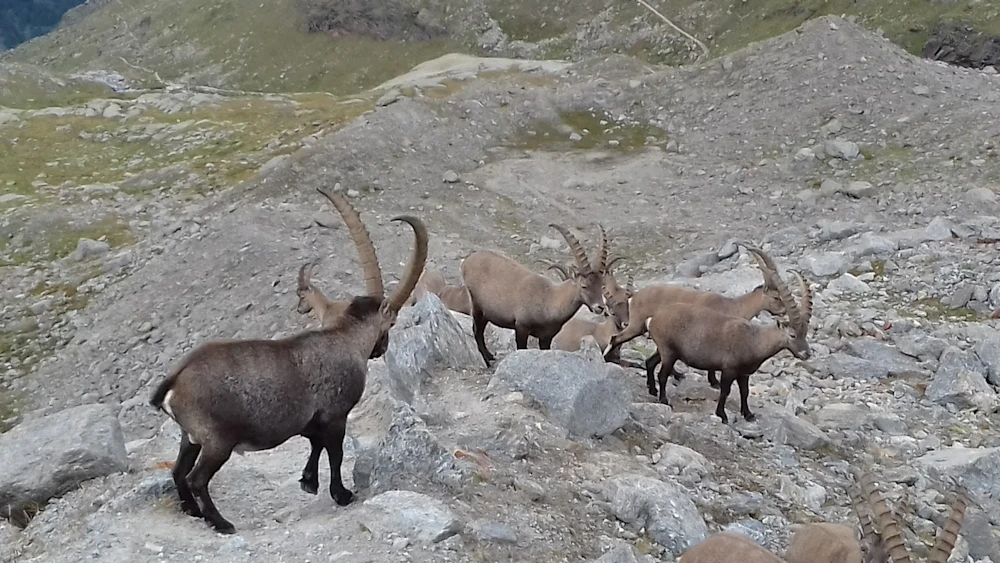
The trekking portion of the program follows a spectacular circuit through the Gran Paradiso National Park, Europe’s first national park, established in 1922 to protect the Alpine ibex from extinction. The park remains one of the most pristine mountain environments in the Alps: a sanctuary of deep valleys, glacial lakes, wildflower meadows, and high rocky passes where ibex, chamois, marmots, and golden eagles are part of the daily scenery.
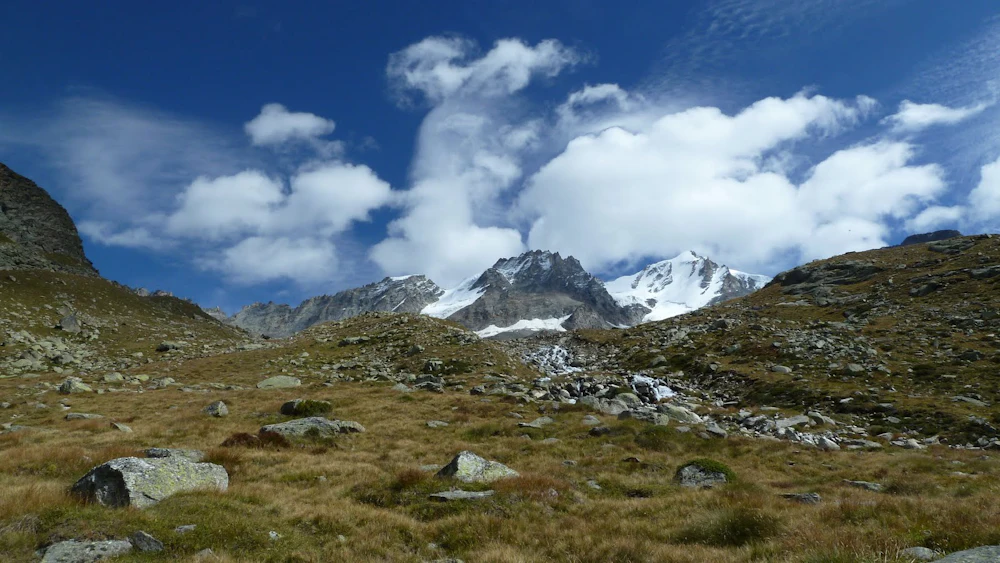
The route crosses five valleys — Valsavarenche, Val di Rhêmes, Valgrisenche, and the Nivolet plateau — connected by passes at 2,875 m, 3,023 m, and 3,082 m. Each valley has its own character: the wide, pastoral landscape of the Nivolet with its lakes reflecting Gran Paradiso; the remote, glacier-carved Val di Rhêmes; the dramatic cliffs above Valgrisenche with views toward the Ruitor massif. The trail moves through larch forests, across alpine pastures where cattle graze in summer, past turquoise glacial lakes, and up through boulder fields to cols where the full scale of the Gran Paradiso massif reveals itself.
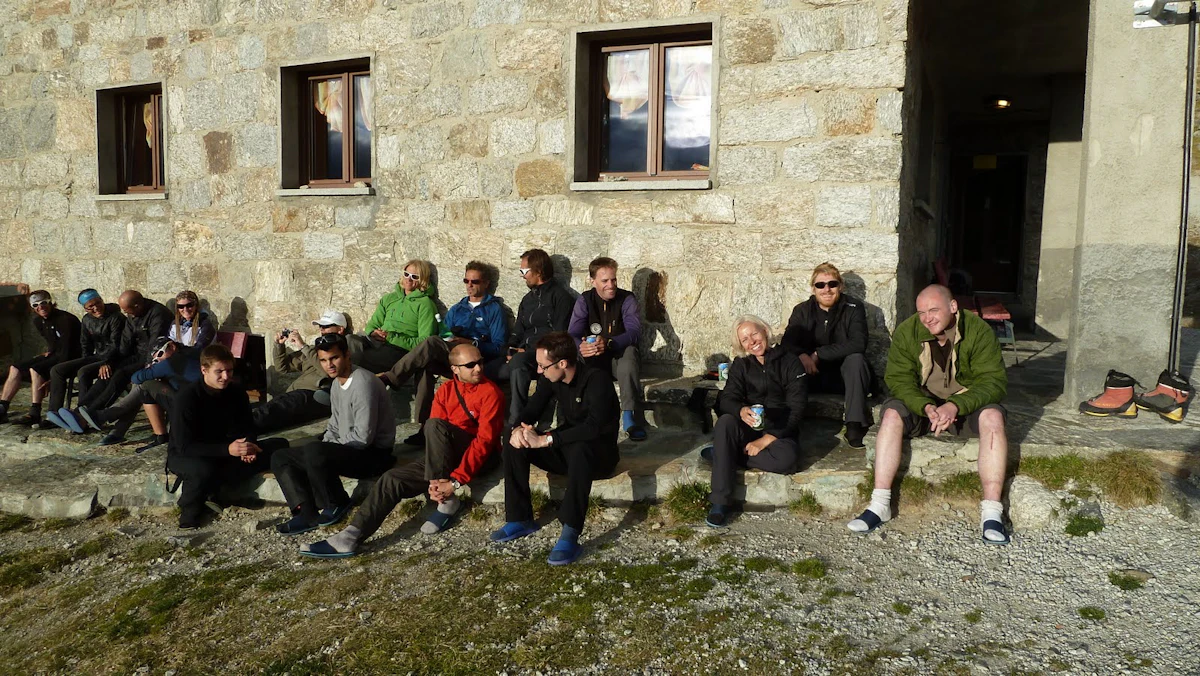
Nights are spent in Italian mountain huts — rifugi — which are a defining part of the experience. Italian hut culture is famously warm: communal dinners with pasta, polenta, and local specialities like fontina cheese and the traditional Valdostan grolle (a communal wooden cup of spiced coffee and grappa passed around the table). The atmosphere is social, generous, and distinctly Italian — a world apart from the more austere character of Swiss or French refuges.
After six days of trekking and the approach to the Chabod Hut, you’ll wake before dawn on Day 8 for the ascent of Gran Paradiso. At 4,061 metres, it is the highest peak entirely within Italy and one of the most accessible four-thousanders in the Alps — but it is a real mountaineering objective, not a walk.
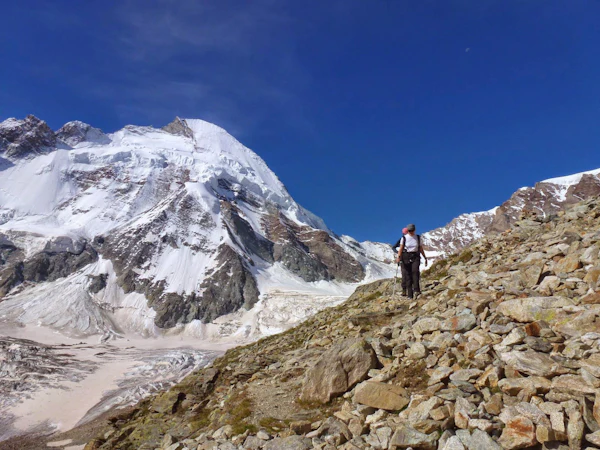
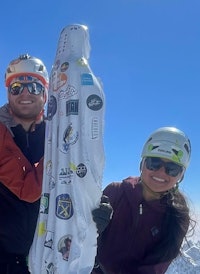
The route from the Chabod Hut crosses the Laveciau Glacier beneath Gran Paradiso’s imposing north face, navigating through crevasse fields and ice cliffs before reaching the Schiena d’Asino (the “Donkey’s Back”) at around 3,700 m. From there, a steeper glacial slope leads to the summit ridge, where a short but exposed section of rock scrambling takes you to the Madonna statue on the summit. The panorama from the top is extraordinary: Mont Blanc, Monte Rosa, the Matterhorn, the Gran Combin, and the peaks of the Vanoise, all visible in a single sweep.
Your UIAGM/IFMGA Mountain Guide manages the glacier travel, the rope work, and the technical decisions throughout the ascent. Previous cramponing experience is not required — your guide will brief you on technique at the Chabod Hut the afternoon before and on the glacier during the ascent. What you do need is the fitness and endurance built up over the previous week of trekking.
Most operators offer the Gran Paradiso trek and the Gran Paradiso summit as separate programs. We’ve designed this as a single, integrated experience because the trek is the ideal preparation for the summit.
After six days of walking 5–7 hours per day at altitude, crossing passes above 3,000 metres, and sleeping in mountain huts, your body is acclimatized, your legs are strong, and you’ve settled into the rhythm of mountain life. Two hotel nights during the trek — in Rhêmes-Notre-Dame on Day 5 and in Pont on Day 6 — provide proper recovery with hot showers, comfortable beds, and good valley meals, so you arrive at the Chabod Hut physically fresh rather than accumulated-fatigue-weary. The approach to the Chabod Hut on Day 7 is deliberately short (approximately 2.5 hours), preserving energy for the big day. And the summit day itself — while long and demanding — arrives at the end of a week when you’re at your fittest and most adapted, not at the beginning when altitude and effort still feel unfamiliar.
The acclimatization profile is carefully managed: you sleep between 2,100 m and 2,500 m for most of the trek, reach 3,082 m on the Col Bassac Déré on Day 3, then sleep at the Chabod Hut (2,710 m) on Night 7 before ascending to 4,061 m on Day 8. This is a progressive, safe altitude build that maximises your chances of reaching the summit feeling strong.
We’ve been guiding in the Gran Paradiso massif for over 20 years. Our guides know these valleys, these huts, and this summit intimately. That experience translates into a program that’s designed around the mountain, not around logistics.
A program that builds to the summit. The six-day trek is not a warm-up — it’s a complete alpine experience in its own right. But it’s also the ideal physical and mental preparation for the ascent of Gran Paradiso. The acclimatization, the fitness, the rhythm of mountain life — everything you need for summit day is built into the week that precedes it.
UIAGM/IFMGA Mountain Guides throughout. Your guide is with you for the entire program — both the trek and the summit. This means they know your fitness, your pace, and your comfort level before summit day arrives. There’s no handover to a stranger on the most important morning of the trip.
Accessible to experienced trekkers. You don’t need to be a mountaineer to join this program. If you’re an experienced hiker with good fitness and a desire to reach a 4,000-metre summit, this is designed for you. The guide teaches the glacier skills; your job is to arrive fit and motivated.
Arrival in the Valsavarenche valley and check-in at your hotel in Pont (1,960 m), a quiet village at the end of the road and the traditional gateway to the Gran Paradiso massif.
Late afternoon meeting with your guide. Gear check, briefing on the week ahead, and an overview of the trekking circuit and the summit plan. Your guide will explain what to expect from Italian hut life, the daily rhythm, and how the trek prepares you for the Gran Paradiso ascent.
Dinner at the hotel. An early night before the first trekking day.
The first day sets the tone. From the hamlet of Pont (1,994 m), we climb through larch forest and alpine pastures toward the Grand Collet (2,832 m), a superb viewpoint that offers the first full panorama of Gran Paradiso — the summit you’ll stand on at the end of the week.
The ascent is sustained but never steep, and the path is well-marked. As you gain altitude, the vegetation thins and the landscape opens into a wide, high plateau dotted with lakes. Ibex are frequently seen grazing on the hillsides here, remarkably unperturbed by passing trekkers — a reminder that this national park was created specifically to protect them.
From the Grand Collet, we descend into the Nivolet valley and reach the Refuge Savoia (2,534 m), beautifully positioned beside the Nivolet lakes with Gran Paradiso reflected in their still water. First communal dinner in an Italian rifugio — an experience in itself.
Ascent: +850 m | Descent: −460 m | Walking time: approx. 4–5 hours
The first pass above 3,000 metres. From the Savoia, we climb through the wide, lake-dotted Plan de Rosset plateau toward the Col Rosset (3,023 m). The approach is gentle and meditative — turquoise lakes, scattered boulders left by retreating glaciers, and the ever-present silhouette of Gran Paradiso behind us.
The col itself offers a magnificent panorama into the Val di Rhêmes, one of the wildest and least-visited valleys in the Aosta region. The descent to the Benevolo Hut (2,287 m) is sustained and takes you through a dramatic change of scenery — from the rocky, mineral world of the col into green alpine pastures where the hut sits in a wide, peaceful valley.
The Benevolo is one of the finest huts on the circuit. The terrace is the perfect place for a cold beer after a long day, and the evening meal is typically excellent. This is where you might experience the grolle — a communal wooden cup of spiced coffee, grappa, and sugar, passed around the table in the Valdostan tradition.
Ascent: +650 m | Descent: −900 m | Walking time: approx. 4.5–5 hours
The most dramatic pass of the trekking circuit and the highest point before summit day. From the Benevolo, we climb steadily through an increasingly wild and rocky landscape toward the Col Bassac Déré (3,082 m).
The final approach to the col is through a vast boulder field, and the panorama from the top is staggering: the Goletta glacier spills down from the peaks above, its seracs and crevasses visible at close range, and the view extends across a sea of peaks in every direction. This is the most alpine moment of the trek — a taste of the high-mountain world you’ll enter fully on summit day.
The descent follows the moraine beside the glacial lake of the Goletta before reaching the Refuge Mario Bezzi (2,284 m), a welcoming hut at the head of the Valgrisenche valley.
Ascent: +1,100 m | Descent: −1,100 m | Walking time: approx. 5.5–6 hours
A change of rhythm. After the intensity of the Col Bassac Déré, today is a gentler traverse — a long, scenic balcony trail high above the Valgrisenche valley.
The path contours along the hillside with expansive views toward the Ruitor massif and its glaciers across the valley. The terrain is varied: forest sections, open pastures, rocky traverses, and the possibility of a detour to the beautiful Lago di San Martino (2,770 m). The pace is unhurried, and the guide uses this day to share knowledge about the geology, the ecology, and the human history of the park.
We arrive at the Refuge de l’Épée (2,373 m), consistently praised for the warmth of its welcome and the quality of its food. A perfect place to recharge before the two final trekking days.
Ascent: +600 m | Descent: −1,450 m (with re-ascent) | Walking time: approx. 5–5.5 hours
The second alpine day of the trek. From the Épée, we climb to the Col Fenêtre (2,875 m) by a well-marked trail with a superb panorama of Gran Paradiso from the top — by now a familiar and increasingly personal presence on the horizon.
The descent toward Rhêmes-Notre-Dame is steep and engaging — the trail follows a sustained and occasionally airy path that requires sure-footedness and concentration. We lose altitude rapidly, dropping through the tree line and into the charming Valdostan village of Rhêmes-Notre-Dame (1,723 m).
Tonight we sleep in a comfortable hotel in the village — a welcome change after four consecutive nights in mountain huts. A long hot shower, a proper bed, and an excellent dinner in the valley: this is deliberate recovery, not luxury for its own sake. Two hotel nights during the program (here and in Pont on Day 6) mean you arrive at the Chabod Hut rested and physically prepared for the summit, rather than worn down by a full week of dormitory sleeping.
Ascent: +700 m | Descent: −1,300 m | Walking time: approx. 5–6 hours
The final trekking day closes the circuit with one last high pass. From Rhêmes-Notre-Dame, we climb through beautiful larch forest to the alpine pastures of Entrelor, then up to the Col de l’Entrelor (3,023 m), passing the beautiful Lago Djouan and Lago Nero on the way — two glacial lakes set in a wide, wild basin surrounded by rocky peaks.
From the col, the view opens once more toward Gran Paradiso, and the descent into Valsavarenche begins. The trail drops steadily through alpine meadows and scattered larch forest, and the village of Pont appears below — the same place where the journey began six days ago. The circuit is complete.
We arrive in Pont in the early afternoon. Check-in at the hotel (where you'll find your luggages) — the second valley night of the program — for another hot shower, a comfortable bed, and a good dinner. After five nights in mountain huts and one in Rhêmes, you’ll be clean, rested, and ready for the summit push. The guide will brief you on tomorrow’s approach to the Chabod Hut and the plan for Day 8.
Ascent: +1,250 m | Descent: −1,100 m | Walking time: approx. 6–7 hours
After breakfast at the hotel, we start our hike to the Chabod hut. The approach follows a beautiful mule track through larch forest and dry-stone walls, climbing through the Lavassey pastures and into the high alpine zone.
About an hour into the walk, the north face of Gran Paradiso appears above — enormous, dark, and streaked with glacial ice. The sight of the mountain from this angle is one of the most impressive in the Alps, and it grows more powerful with every step as you approach the hut.
The Rifugio Chabod (2,710 m) sits directly below the north face, in one of the most dramatic hut positions in the Gran Paradiso massif. We arrive in the early afternoon, leaving time to rest, eat, and prepare for tomorrow. If you’ve chosen to rent technical gear (crampons, ice axe, harness, helmet), it will be available at the hut — your guide will help you fit everything and make sure it’s adjusted correctly. Your guide will then conduct a thorough briefing on the ascent: the route, the timing, the rope system, cramponing technique, and what to expect from the summit block.
Dinner at the Chabod is hearty Italian mountain food — pasta to fuel the early start. You’ll lay out your gear for the morning, and lights are out early. Breakfast will be at 4:30 a.m.
Ascent: +876 m | Walking time: approx. 3 hours
The alarm sounds before dawn. Breakfast at 4:30 a.m., and we leave the hut by 5:15, head torches on. The trail climbs gently at first across moraine and rocky ground, beneath the massive north face of Gran Paradiso. The stars are still out, and a line of head torches from other parties marks the route ahead.
As dawn breaks, we reach the Laveciau Glacier. Here we rope up, strap on crampons, and begin the glacier ascent. The route navigates through crevasse fields and past ice cliffs — your guide manages the rope and the route finding, and you focus on the steady rhythm of cramponing uphill. As you gain altitude, the view opens behind you: the great bulk of Mont Blanc appears on the northern horizon, glowing pink and white in the early morning light.
At around 3,700 m, we reach the Schiena d’Asino — the “Donkey’s Back” — where the Chabod and Vittorio Emanuele routes merge. A short rest, then we continue up a steeper glacial slope toward the summit ridge. The final section is a short scramble on rock — exposed but brief, with the guide providing close support. And then you’re standing at the Madonna statue on the summit of Gran Paradiso (4,061 m), with the entire arc of the western Alps spread beneath you.
This is the moment the entire week has been building toward.
The descent follows the south side of the mountain toward the Vittorio Emanuele Hut (2,735 m), creating a satisfying circular route. From the hut, we continue down through alpine meadows and larch forest to Pont (1,960 m), arriving in the mid afternoon.
Celebration in Pont. The tour of Gran Paradiso — six trekking days, five valleys, three passes above 3,000 metres, and one 4,000-metre summit — is complete.
Ascent: +1,350 m | Descent: −2,100 m | Walking time: approx. 9-10 hour
The Tour of Gran Paradiso with Summit is a demanding program that combines a multi-day trek with the ascent of a 4,000-metre peak. You do not need previous mountaineering or glacier experience, but you must be physically prepared for sustained effort at altitude over eight consecutive days.
Cardiovascular fitness. You should be comfortable hiking 5–7 hours per day on consecutive days, with elevation gains of up to 1,100 metres in a single stage. On summit day, expect 7–9 hours of effort with approximately 1,350 m of ascent and 2,100 m of descent.
Mountain hiking experience. You should have experience walking multi-day routes in mountainous terrain and be comfortable on steep, rocky, and occasionally exposed paths.
Pack carrying ability. You will carry your own pack throughout the trek (approximately 7–8 kg).
No previous mountaineering experience required. Your UIAGM/IFMGA guide will teach you all the glacier and crampon technique needed for the Gran Paradiso ascent. The briefing takes place at the Chabod Hut the evening before, and the guide reinforces skills on the mountain itself.
We recommend preparing with regular endurance training in the months before the program: hiking with a loaded pack, running, cycling, or any sustained cardio activity. Core strength and leg strength exercises are also valuable.
If you’re unsure whether your fitness level is sufficient, please reach out to us. We’re happy to discuss your experience and help you assess your readiness.
Yes. Crampons, ice axe, climbing harness, and helmet are all available for rental directly at the Rifugio Chabod. The complete kit costs €40, payable on site. Your guide will help you fit and adjust all rental gear during the briefing on the evening before summit day. If you do bring your own equipment, please make sure your crampons are compatible with your boots — your guide will check this during the gear review on Day 0 (you will be able to leave them with your luggages at the Hotel in Pont during the trekking part).
No. The Gran Paradiso ascent from the Chabod Hut is one of the most accessible glacier climbs in the Alps. Your guide will teach you crampon technique, roped glacier travel, and how to move on the summit ridge during the briefing at the hut and on the mountain itself. What we do require is solid hiking experience and good fitness.
Yes. Before setting off on Day 1, you can leave a bag at the hotel in Pont with anything you won't need on the trail — fresh clothes, travel items, summit day extras, or simply a change of outfit for when you return. Your luggage will be stored safely and waiting for you when you arrive back in Pont on Day 6. This means you only carry what you actually need for the six trekking days, keeping your pack light and comfortable.
The trekking days involve 5–7 hours of walking per day with elevation gains of 650–1,150 metres. The terrain includes well-marked trails, rocky passes, and some steep, occasionally exposed descents. Summit day is the most demanding: approximately 7–9 hours of effort with 1,350 m of ascent and 2,100 m of descent, including glacier travel and a short rock scramble to the summit. Good fitness and endurance are essential.
Italian rifugi are known for their generous hospitality and excellent food. Dinners are typically three courses: a starter or soup, a pasta or polenta main course, and dessert. The atmosphere is social and warm. Sleeping is in dormitory-style rooms with blankets provided — bring a sleeping bag liner. Most huts have hot showers available (sometimes coin-operated). The Benevolo and Épée huts are particularly well-regarded for their welcome and cuisine.
The guiding ratio is 1:8 max for the trekking part and 1:4 max for the 2 days of the Gran Paradiso summit.
Lunch is not included. We recommend bringing easily digestible, high-energy food: cereal bars, dried fruit, nuts, chocolate. Every day it will be possible to buy packed lunches at the huts or at the hotels, for the following day.
The nearest major airports are Geneva (approximately 2.5 hours by road via the Mont Blanc tunnel), Turin (approximately 2 hours by road) and Milan Malpensa (approximately 2.5 hours). The nearest town with rail access is Aosta, from where a local bus or taxi reaches Pont in approximately 45 minutes. We can recommend transfer options on request.
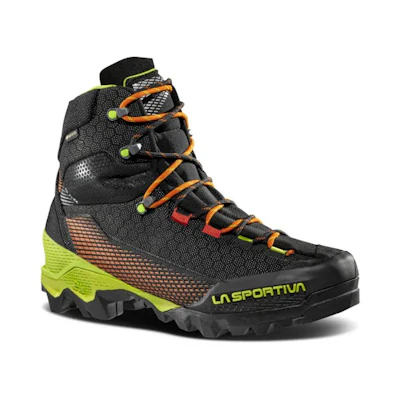
Stiff-soled mountaineering boots compatible with crampons. Not trekking boots. Break them in well before the trek.
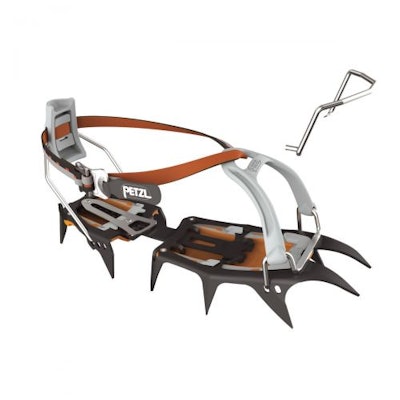
10- or 12-point steel crampons compatible with your boots
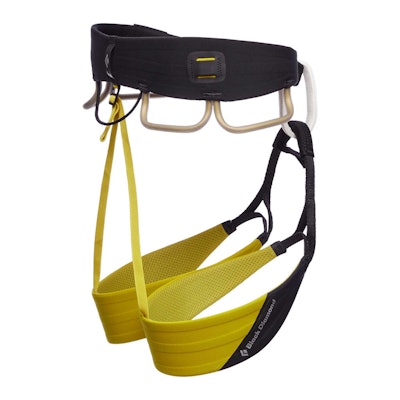
A lightweight, comfortable harness.
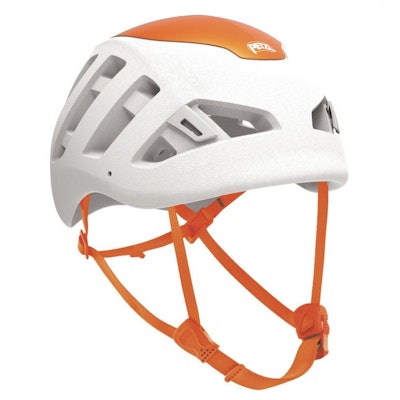
A lightweight, durable climbing helmet. It should provide solid protection while being well-ventilated and comfortable for extended wear during the trek.
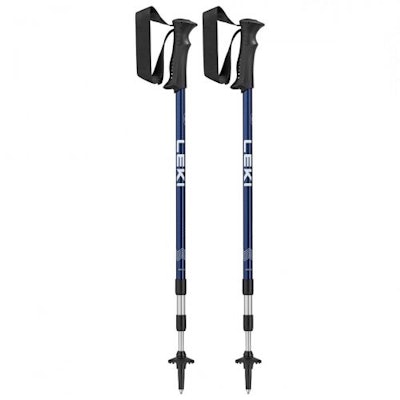
Collapsible trekking poles for balance and support.
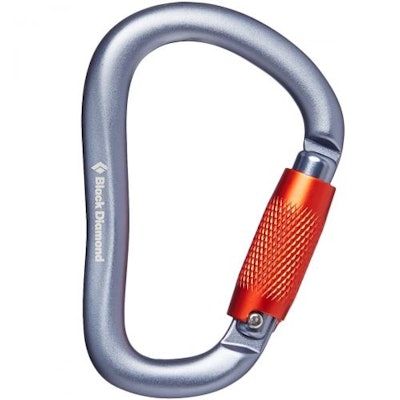
One locking carabiner.
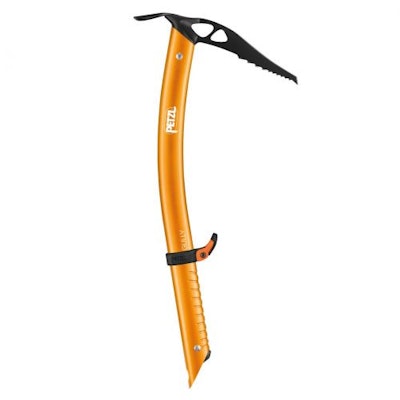
A basic mountaineering ice axe (50–60 cm)
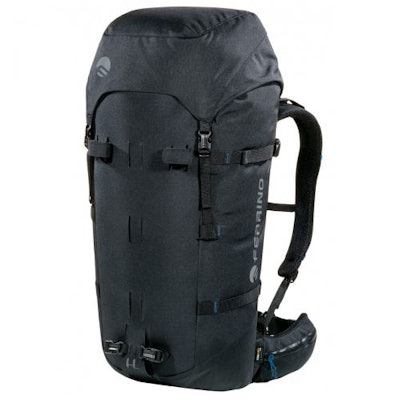
A 30–40 litre pack with attachment points for ice axe and crampons. Must fit comfortably with a hip belt.
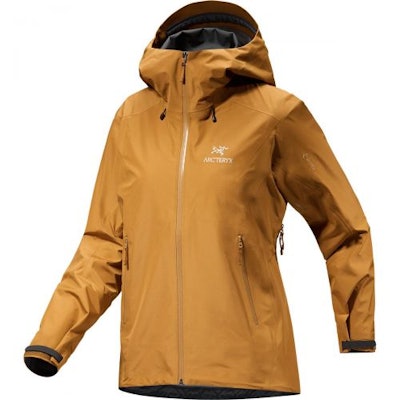
Your hardshell jacket must include a hood for full protection from wind, rain, and snow. Waterproof and breathable, it serves as a critical outer layer, ensuring comfort and mobility in harsh conditions.
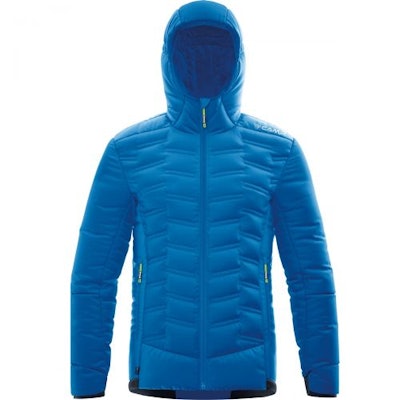
Pack a down jacket to ensure warmth in cold conditions. Its insulation traps body heat, making it ideal for high altitudes and freezing temperatures, while remaining lightweight and compressible.
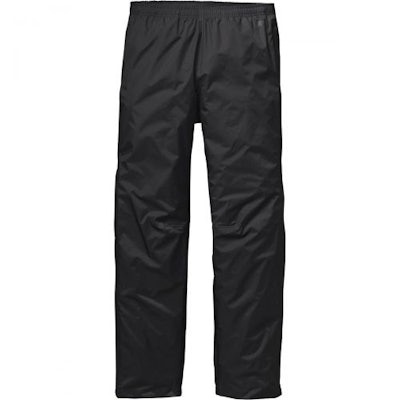
Waterproof, windproof, with full-length side zips.
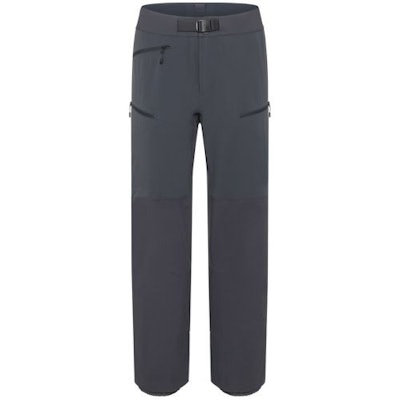
Softshell or stretch fabric, wind-resistant.
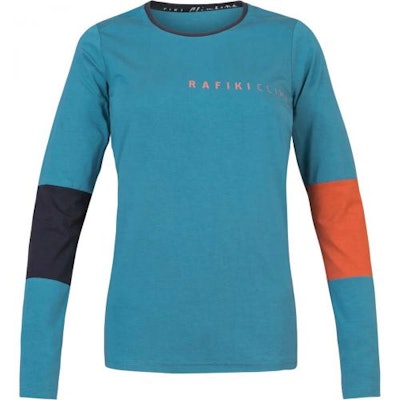
Merino wool or synthetic. Avoid cotton
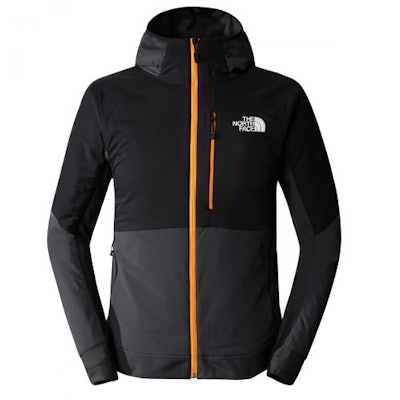
A midlayer top is essential for insulation and must fit comfortably over your baselayers. It provides warmth while allowing for breathability, making it ideal for varying temperatures during your tour.
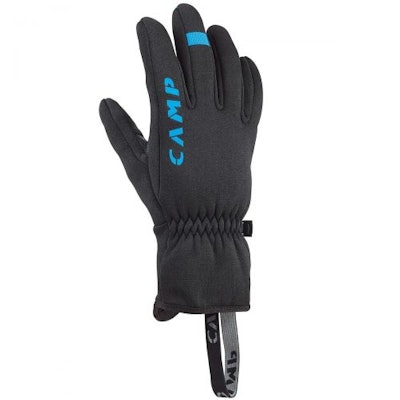
Bring full-finger thin gloves for dexterity and light protection during the Haute Route. They offer warmth in mild conditions while allowing precise hand movements.
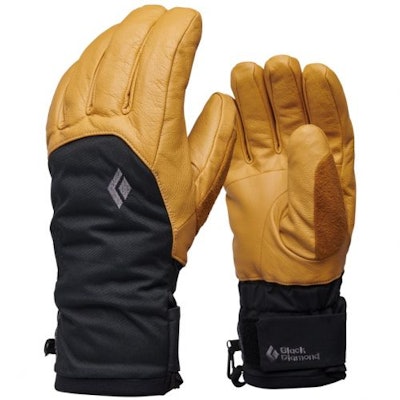
Full-finger softshell gloves are essential for protection against wind and light moisture. They offer warmth, durability, and flexibility, ensuring ease of movement while handling gear in cold conditions.
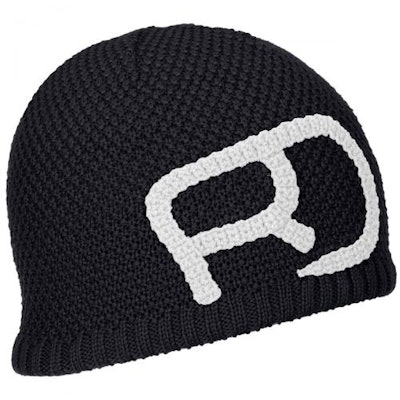
Insulating beanie for early starts and hut evenings.
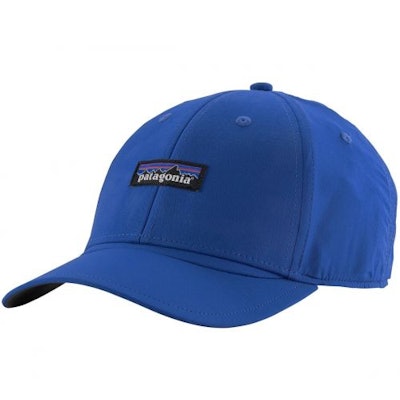
Brimmed hat for sun protection during the day.

Versatile protection against sun, wind, and cold.
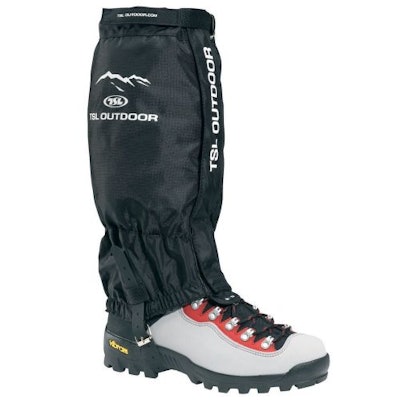
To keep snow and debris out of boots on glacier terrain.
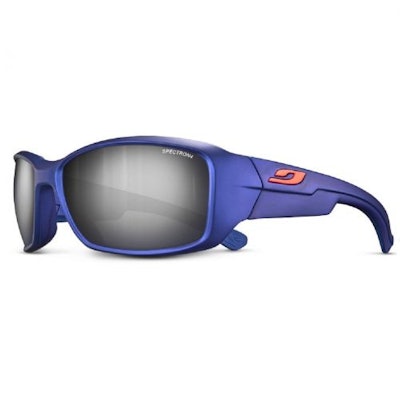
Bring sunglasses with high protection (grade 3 or 4) to protect your eyes from intense sunlight and glare at high altitudes, ensuring clear vision and reducing eye strain.
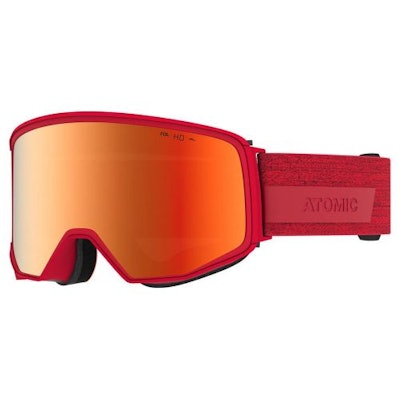
Bring ski goggles to protect your eyes from blizzards, strong winds, and cold. They ensure clear vision and shield your face from harsh weather conditions.
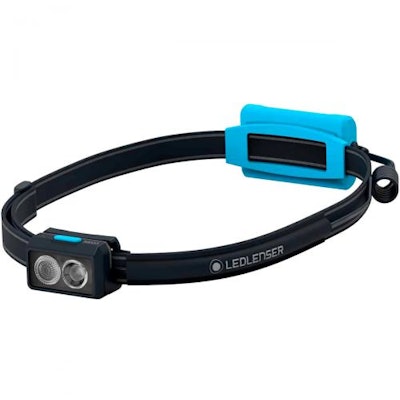
Bring a headlamp with new batteries and a minimum output of 300 lumens.
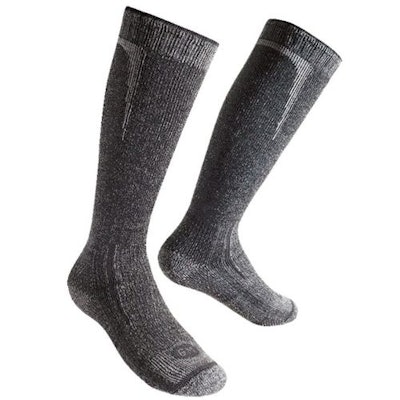
Pack three pairs of hiking socks, long ones, for added protection. They help prevent blisters and ensure your feet stay comfortable throughout your trip.
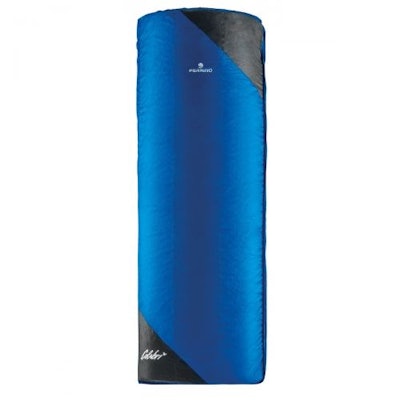
Mandatory in all Alpine huts. Silk is lightest and most comfortable.
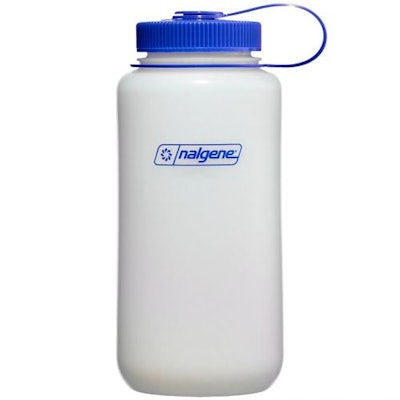
A hydration system with at least 1 liter capacity is essential, depending on your drinking habits. Camelbacks work well but may freeze in cold conditions, so plan accordingly to stay hydrated.
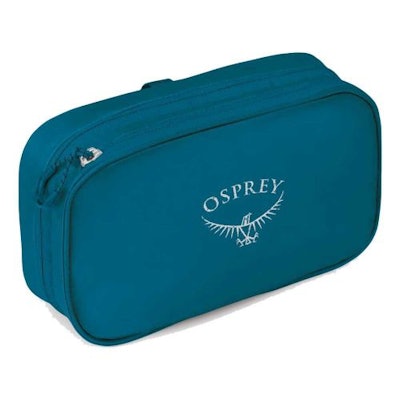
A personal care bag is essential for your trip. Include a toothbrush, toothpaste, first-aid tape, Band-Aids and any personal medications or prescriptions for a safe and comfortable journey.
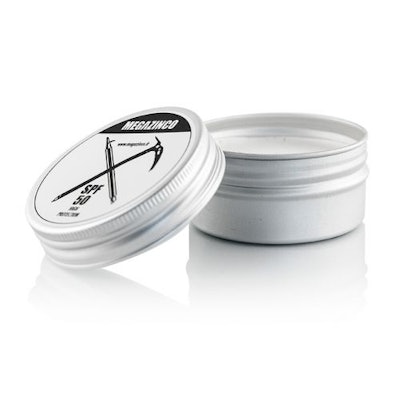
Sunscreen with SPF 50 is essential for high mountain conditions, providing superior protection against harmful UV rays. Apply generously to all exposed skin to prevent sunburn during the tour.
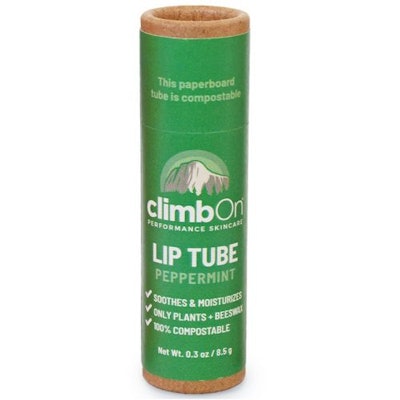
A high-protection lipscreen is essential for shielding your lips from UV rays and harsh weather in the mountains. It helps prevent chapping and sunburn, keeping your lips moisturized and safe.

Earplugs are a must-have for your trip, especially if you find yourself in a hut with a neighbor who thinks they're auditioning for a snoring competition. Enjoy some peace and quiet!
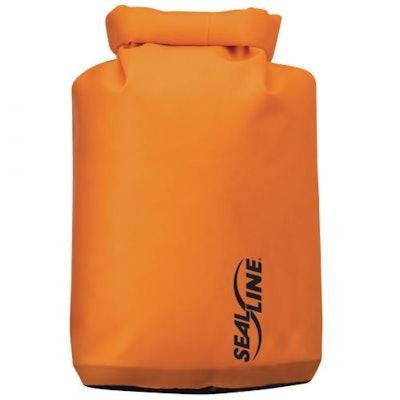
Keep your personal documents in a waterproof bag to protect them from moisture and damage. This ensures that essentials like your ID, permits, and insurance information stay safe.
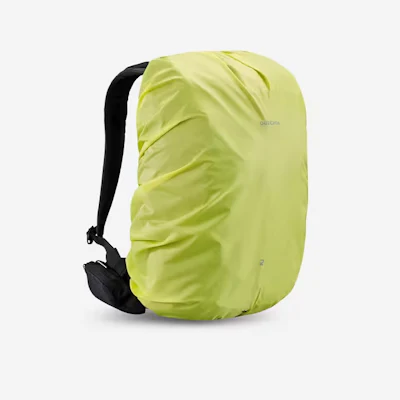
Lightweight, fitted to your pack size. Essential for keeping gear dry on rainy days.