From 4.150 €
5 (7 Reviews)
17 Dates
I have some questions 🙋The heart of the Tour du Mont Blanc in seven days — a hotel-to-hotel traverse from Courmayeur to Chamonix through Italy, Switzerland and France, following the most celebrated sections of the classic circuit, with a comfortable return transfer to Courmayeur at the journey's end. Guided walking carrying nothing but a light daypack, and every night in a hand-picked hotel: 4-star spa addresses in Courmayeur, Verbier and Martigny — where an evening in the town's Roman baths follows the hardest day on the trail — and two characterful village hotels right on the trail itself. Every transfer, packed lunch and dinner is taken care of, from the welcome pizza on your first night to the unforgettable finale: a farewell dinner beneath the century-old vaults of a Michelin Guide-selected restaurant in the heart of Courmayeur — the celebration your week in the mountains will have earned.
Led throughout by IFMGA Mountain Guides and International Mountain Leaders — and on departures of more than six, by two guides rather than one, so the group is always well looked after: as far as we know, the only operator on the Tour du Mont Blanc to do this. Starting and finishing in Courmayeur.
Our 2026 departures are sold out — bookings for 2027 are now open.
We run small-group departures of our 7-day Tour du Mont Blanc Deluxe between mid June and mid September, each beginning on a Sunday: you arrive in Courmayeur with our included Geneva transfer, meet your guide and gather for the welcome pizza, and take your first steps on the trail on Monday morning. Places are limited and the classic summer dates fill early.
Guests who confirm their place during our early bird window — by 30 September 2026 — receive a €200 discount off the standard price. Reserve your spot with a deposit today to lock in the early bird rate.
The Tour du Mont Blanc is the most famous long-distance trek in the Alps: roughly 170 kilometres circling the entire Mont Blanc massif through three countries — Italy, Switzerland and France — with around 10,000 metres of cumulative ascent and descent. It is a genuine bucket-list journey — and not everyone can give it eleven days.
This is why we created the 7-day edition of our Tour du Mont Blanc Deluxe. Rather than rushing the full circuit, we've made a cleaner choice: this tour follows the finest half of the TMB, a point-to-point traverse from Courmayeur to Chamonix that crosses all three countries and gathers the route's most celebrated moments — the Val Ferret balcony beneath the Grandes Jorasses, the border crossing of the Grand Col Ferret, an evening in Verbier, the Roman baths of Martigny, the return of Mont Blanc at the Col de Balme, and the grand balcony of the Aiguilles Rouges — into a single, unhurried week.
At the end of the trek, a comfortable transfer through the Mont Blanc tunnel returns you to Courmayeur, where the journey closes the way it began: around a table. If you have the time, our 11-day circuit remains the complete experience; if a week is what your calendar allows, this is the best week the TMB has to offer.
The formula is identical to our classic version, and it is built around a simple conviction: the walking should be everything, and everything else should be handled. The trail is exactly as demanding as it has always been — that is the point, and the privilege. What changes is everything around it.
You carry only a light daypack; your main luggage travels ahead by road each morning and is waiting at reception when you arrive. Every dinner, every packed lunch, every transfer — from the moment we collect you at Geneva airport to the moment we return you — has been arranged before you take your first step. Your only task is to walk through some of the finest mountain scenery on earth.
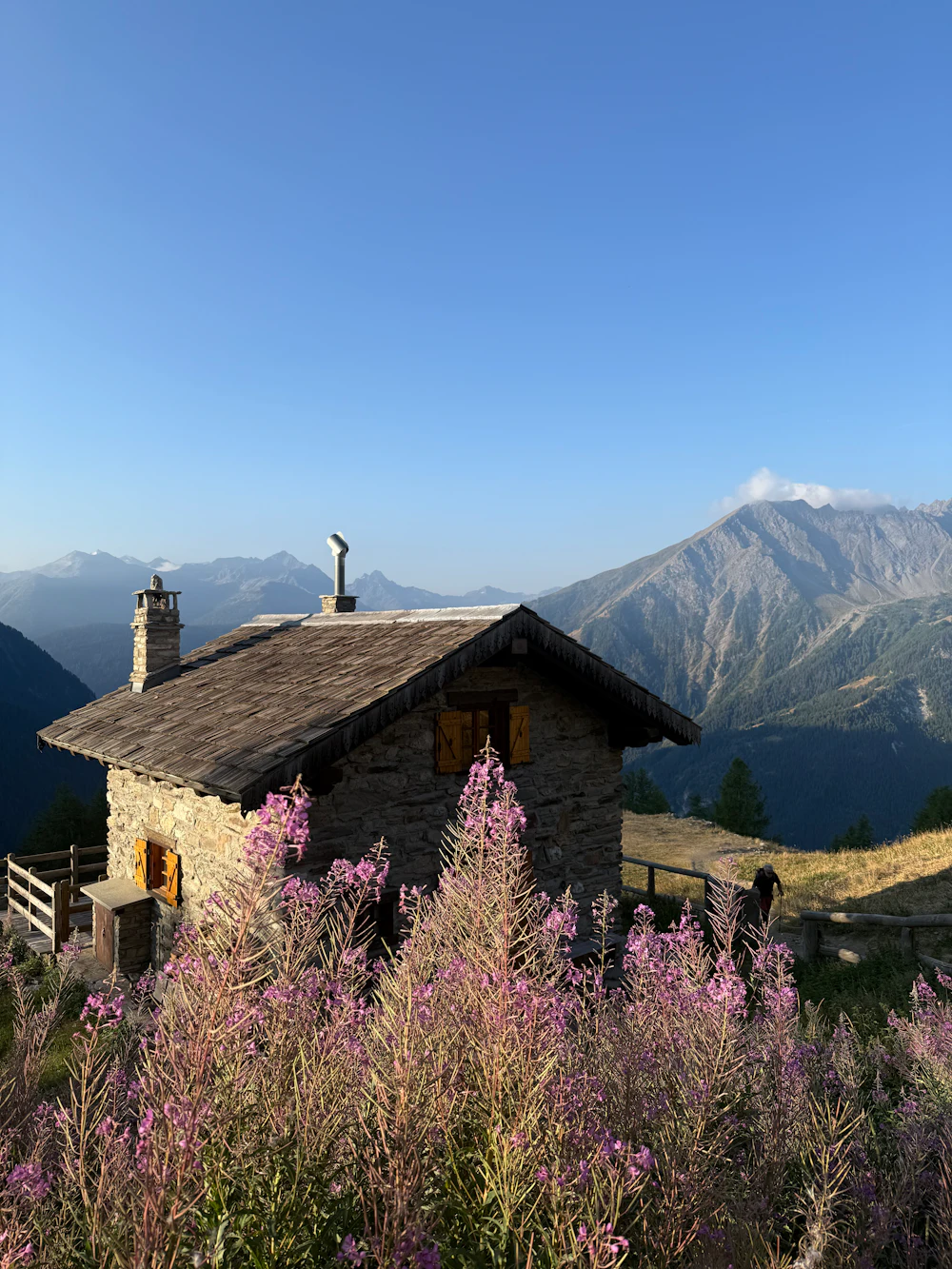
And at the end of each day, you arrive somewhere worth arriving. No dormitories, no queues for the shower: every night of the trek is spent in a hand-picked hotel with genuine alpine character — double or twin rooms, private bathrooms, and, at most stops, a spa or wellness area to draw the day's kilometres out of your legs. The accommodation shifts with the landscape, by design: in the towns, 4-star spa hotels; on the trail itself, one authentic village house in Argentière, the mountaineering village of the Chamonix valley, where the hotel's sauna and steam room wait at the end of the day.
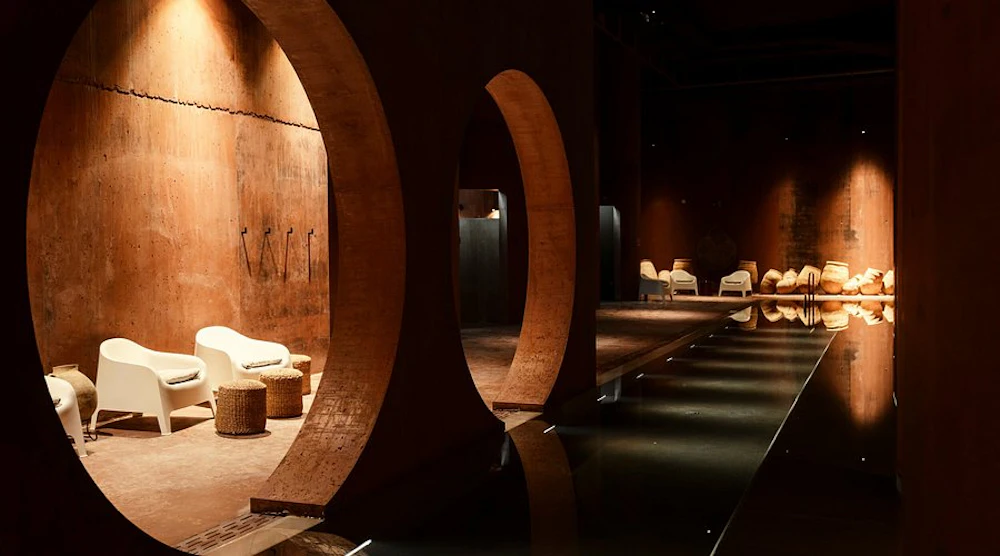
Three evenings deserve special mention. After the border crossing of the Grand Col Ferret, a private transfer carries you up to Verbier, one of the most celebrated resorts in the Alps, for your first Swiss night on its sunny balcony above the Val de Bagnes. The next night brings the centrepiece: after the biggest walking day of the trek, instead of overnighting in a mountain village, you descend to Martigny — Roman Octodurus two thousand years ago — where your final Swiss evening is spent drifting through the warm pools and steam of the town's Roman baths before dinner and a deep valley sleep. Recovery, done as the Romans did it. And the last night of the trip is spent at a superb hotel in the heart of Courmayeur, before the farewell dinner.
After eight hours on the trail, the difference this makes to how you sleep, recover and feel the next morning is not a detail — it is the reason our guests finish the trek strong, and the reason this version of the TMB carries the name Deluxe.
We walk anticlockwise from Courmayeur, on the sunny Italian side of the massif, to Chamonix, the world capital of mountaineering. There is a good reason for this. Most groups set off from Chamonix at the weekend, so by beginning on the Italian side you slip neatly between the big weekend waves and walk noticeably quieter trails — while still following the classic, best-waymarked direction with the most rewarding views ahead of you rather than behind. And although the walking ends in Chamonix, the trip doesn't: the included transfer brings you back through the Mont Blanc tunnel to Courmayeur for the final evening, so the journey starts and finishes in the same place — with the whole massif walked across in between.
Your group is led by an IFMGA Mountain Guide or a qualified International Mountain Leader — a professional who lives and works in these valleys, knows every variant, shortcut and weather window, and chooses the best line each morning for the group and the conditions. When clouds sit on one pass, your guide knows which balcony trail will be clear. When an afternoon storm is forecast, the day starts earlier and the pace is managed accordingly. And on departures of more than six walkers, you're accompanied by two guides rather than one — so the group can flex naturally by pace, no one is ever left waiting or pushed, and there's always an expert eye at both ends of the group. As far as we know, we're the only operator on the Tour du Mont Blanc to guide this way. This is the difference between following a route and being guided around a mountain.
From the moment you land, the trip is taken care of. Transfers from Geneva airport to Courmayeur and back are included — along with the return transfer from Chamonix to Courmayeur at the end of the trek, every night of accommodation, every breakfast, a freshly prepared packed lunch for each trekking day, and every dinner, from your first evening to your last.
Each day on the TMB ends with a real sense of arrival, and we mark the two evenings that matter most. On your first night in Courmayeur, the group gathers for a welcome pizza — the proper Italian start to a journey that begins on Italian soil. A week later, having walked across three countries from Courmayeur to Chamonix, the celebration rises to the occasion: a farewell dinner beneath the brick vaults of one of Courmayeur's oldest restaurants, a Michelin Guide-selected address in the historic heart of the village — a long table, refined Valdostan cooking, an excellent cellar, and the shared satisfaction of a traverse of the Mont Blanc massif completed on foot.
Between those two evenings, dinners are taken in the hotels and villages along the way — mountain cooking that changes character as you cross borders, from polenta and fontina in the Aosta valleys to rösti in Switzerland and Savoyard classics in France. Eating your way across the Alps is, quite honestly, part of the route.
The hotels are chosen with the same care as the trail itself. Each one is a characterful property with a warm welcome — and every single one has a spa or wellness area to ease tired legs (included in the price). Your bag is at reception when you walk in. A hot shower, a real bed and an unhurried dinner every single night: this is how a demanding trek stays enjoyable from your first day on the trail to your last.
We have been guiding around the Mont Blanc massif for over 20 years. Our guides don't visit these valleys in summer — they live in them. That local depth shapes every decision on this program, from the sections we walk to the hotels we book.
The finest days, not a compressed circuit. Squeezing the full TMB into a week means long days and skipped sections. We've taken the honest approach instead: a traverse built entirely from the most celebrated stages of the route, walked at the unhurried pace they deserve. You experience the best of the Tour du Mont Blanc — not a hurried version of all of it.
Comfort that serves the trekking. The TMB is a genuinely demanding trek, with sustained climbs and long descents on consecutive days. Recovery is what makes it sustainable. A quiet room, a private bathroom, a proper dinner and your own luggage waiting at reception mean you start each morning restored rather than merely rested. We designed this program hotel-to-hotel because it is the version of the TMB that lets you enjoy all of it.
One price, no surprises. Airport transfers from Geneva, every meal from the welcome pizza to the farewell dinner at a Michelin Guide-selected restaurant, packed lunches on the trail, luggage transfers, an evening at the Roman baths in Martigny, and professional guiding throughout. All included. You book once, and then your only job is to walk.
Local guiding, real decisions. Weather around Mont Blanc changes fast, and the TMB is full of variants. A guide who knows the massif intimately turns those variants into opportunities — a clearer col, a quieter balcony, a better lunch spot — rather than problems. This is what you cannot get from a guidebook or a GPX track.
The UTMB competition. Every year, at the end of August, the Ultra-Trail du Mont-Blanc — the most famous trail race in the world — brings some ten thousand runners, and many times that number of supporters, onto the very trails of the TMB. It is a magnificent spectacle, but not the week for a peaceful trek: paths become race courses, villages become finish lines, and hotels along the route fill a year in advance. We deliberately schedule no departures that would put you on the trail during UTMB week, so your traverse unfolds at the mountain's own rhythm — not the race's.
The journey ends in Courmayeur — and Courmayeur is a very good place to linger. If you'd like to extend your stay and treat yourself to one last alpine experience, two ideas come warmly recommended by our guides.
A recovery day at QC Termemontebianco. A few minutes from Courmayeur, in Pré-Saint-Didier, the QC Terme thermal spa is one of the finest in the Alps: outdoor thermal pools facing the Mont Blanc massif, saunas, steam rooms and relaxation spaces built around waters that have been used for recovery since the 1800s. After a week on the trail, an afternoon drifting between warm pools with the mountains you just crossed filling the horizon is, in our experience, the perfect final chapter.
Skyway Monte Bianco. Alternatively — or additionally — ride one of the most spectacular cable cars in the world from Courmayeur to Punta Helbronner at 3,466 m, in rotating panoramic cabins that lift you from the valley floor into the glacier world in minutes. From the top terrace you stand among the granite spires and séracs of the massif you have just walked beneath, with Mont Blanc close enough to read the texture of its ice. It is a remarkable way to see your entire route from above, and a fitting farewell to the mountain.
Both are easy to arrange independently, and we're happy to advise on timings, an extra hotel night in Courmayeur, or a later transfer if you decide to stay on.
Your Tour du Mont Blanc begins the easy way: we collect you. A shared group transfer departs Geneva airport at 15:00 and is included in the price of the trip — a scenic two-hour drive through the Mont Blanc tunnel that delivers you directly from the arrivals hall to the Italian side of the massif. If your flight schedule doesn't fit the 15:00 departure, we can arrange a private transfer at any time of day for an additional cost — just let us know when you book.
Courmayeur is the perfect place to start. An elegant alpine town at 1,224 m with a car-free centre of cobbled lanes, mountain outfitters and cafés, it sits directly beneath the south side of Mont Blanc — and from the moment you step out of the vehicle, the scale of the mountain you're about to walk around is unmistakable.
And your first arrival sets the tone for the whole trip. Home in Courmayeur is a beautiful 4-star hotel with its own spa, steps from the historic centre — and with the afternoon free before the briefing, there's no better introduction to the Deluxe way of doing the TMB than an hour in the wellness area: pool, sauna and steam beneath the mountain you'll spend the coming week circling. Travel done, boots still in the bag, and already recovering from a journey you haven't started — this is the standard every evening of the trek will keep.
At 6 pm, the early-evening meeting with your guide. This is a relaxed but thorough briefing: introductions around the group, an overview of the days ahead, a look at the route and the rhythm of the trek, and a check that everyone's daypack and gear are in order. Your guide will explain how the luggage transfers work, what each morning looks like, and answer any questions about the days to come.
Then, the proper Italian start to the journey: the group heads out together for the welcome pizza — wood-fired, unhurried, and accompanied by the first of many good conversations. By the time you walk back to the hotel through the quiet evening streets, with the summits above town catching the last light, the trek has already begun in spirit. Tomorrow, it begins on foot.
Shared transfer from Geneva at 15:00 (included) | Private transfer available on request (extra cost) | Night in Courmayeur (4-star hotel with spa) | Meals: welcome pizza dinner
The Tour du Mont Blanc does not ease you in gently — it opens with one of its finest days, and we've placed it first deliberately.
From the hotel, we climb out of Courmayeur on a well-graded trail that switchbacks up through cool larch and pine forest, the town shrinking below with every turn. It's a sustained ascent — around an hour and a half of steady effort — and it ends at Rifugio Bertone (1,989 m), perched on a grassy shoulder high above the valley. This is the moment the trek reveals itself: as you round the final bend to the hut, the entire chain of the Mont Blanc massif appears across the Val Ferret, close enough to feel almost within reach.
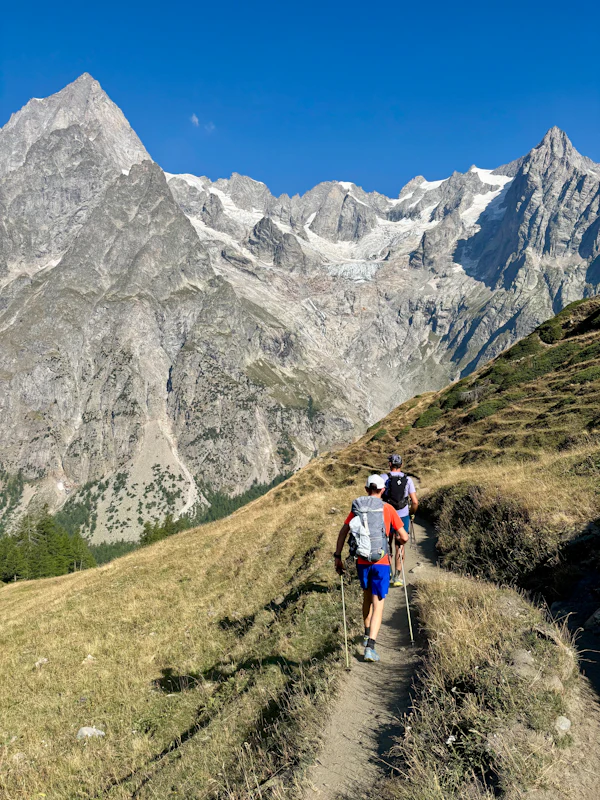
What follows is, for many walkers, the most beautiful stretch of the entire circuit. The balcony trail runs north-east along the flank of the Mont de la Saxe at around 2,000 m, contouring through alpine meadows thick with wildflowers in early summer, with almost no climbing and nothing to do but walk and look. And there is a great deal to look at: directly opposite, the vast north walls of the Grandes Jorasses rise nearly two and a half vertical kilometres from the valley floor, flanked by the slender granite tooth of the Dent du Géant and glacier after glacier spilling from the high massif. Few trails anywhere in the Alps hold a view like this for so long.
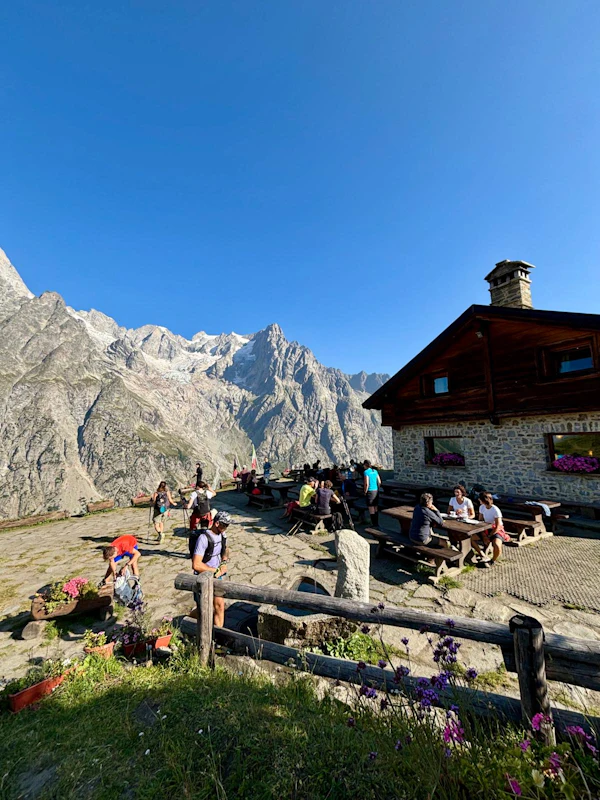
By early afternoon we reach Rifugio Bonatti (2,025 m), named after the great alpinist Walter Bonatti, who considered this side of Mont Blanc the most beautiful in the range — from the hut's terrace, you'll understand why. It's the natural place for a long pause: an espresso or a slice of homemade cake, boots off, the Jorasses filling the horizon.
From Bonatti, a pleasant descent through pastures and scattered larches brings us down to the floor of the Val Ferret at Arnouva, where our private transfer is waiting. Twenty minutes later you're back at your 4-star hotel in Courmayeur for a second night — and this is where the Deluxe formula shows its worth after a first real day on the trail: straight from the trail to the spa, pool and sauna working on the day's 1,100 metres of climbing, then a hot shower, a relaxed dinner, and no need to repack. Your first mountain day, closed the way every one on this trek will be.
Ascent: +1,100 m | Descent: −700 m | Distance: approx. 17 km | Walking time: approx. 6 hours | Night in Courmayeur (4-star hotel with spa) | Meals: breakfast, packed lunch, dinner
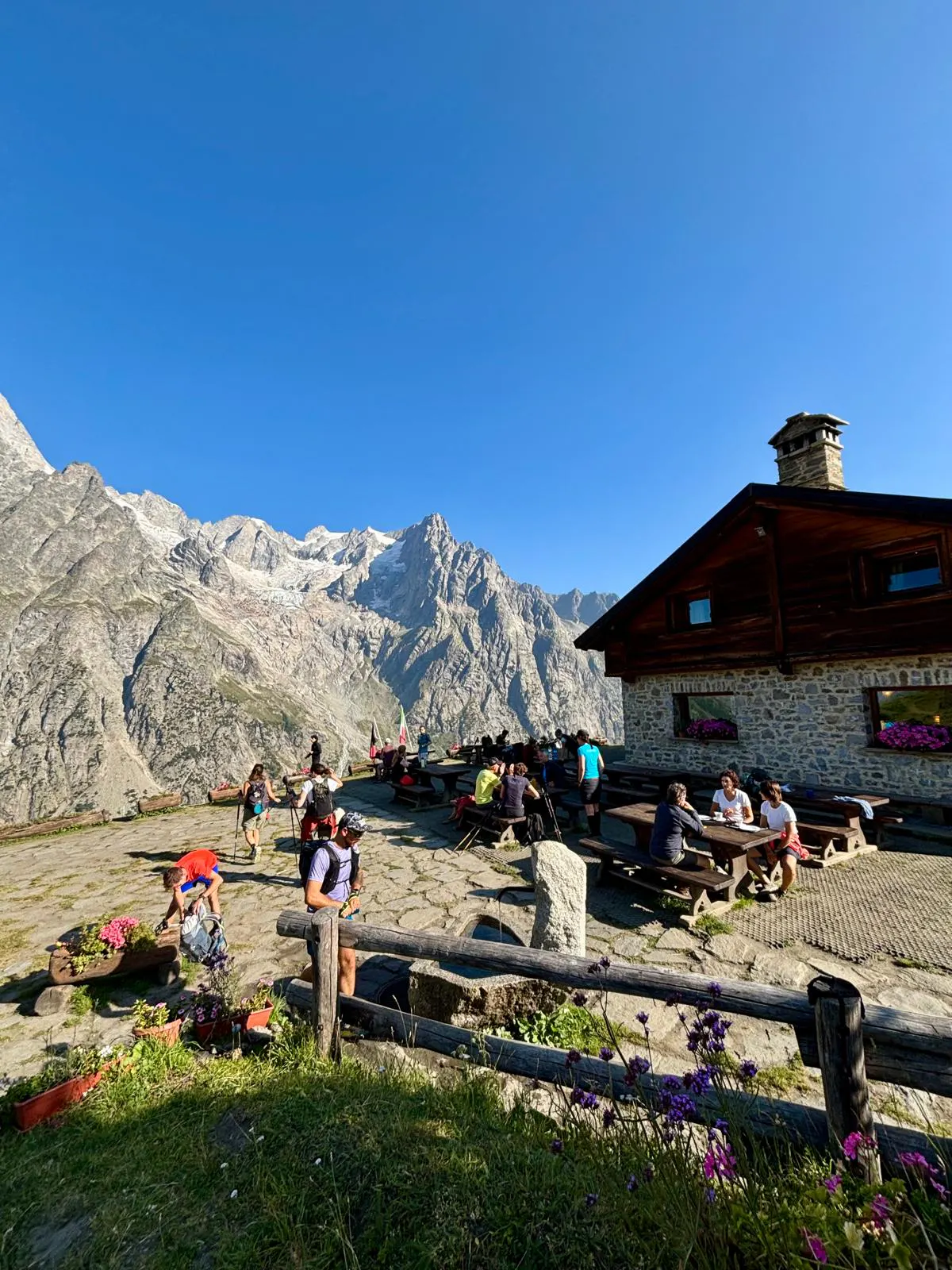
Today the tour crosses its first international border — on foot, over a 2,500-metre pass, which is the only proper way to do it.
After breakfast, the short transfer runs us back up the Val Ferret to Arnouva, exactly where we left the trail yesterday, and the day's work begins immediately: the long climb to the Grand Col Ferret (2,537 m), the highest point of the tour so far. On paper it looks like a serious undertaking — some 900 metres of ascent — but the gradient is remarkably kind. The trail rises in broad, unhurried curves through open alpine terrain, and the rhythm settles quickly. Of all the major passes on the Tour du Mont Blanc, this is the one that lets you climb high while feeling like you're simply out for a magnificent walk.
And the views reward every metre. As we gain height, the head of the Italian Val Ferret unfolds behind us, dominated by the elegant pyramid of Mont Dolent — the peak where Italy, Switzerland and France meet at a single summit point. The glaciers of Pré de Bar hang beneath it, and the great wall of the massif we walked below yesterday stretches away to the south-west, now seen end to end.
The col itself is a genuine threshold. In a few steps you cross the watershed, Italy falls away behind you, and Switzerland opens ahead — and the landscape seems to know it. The Swiss Val Ferret is a different world: softer and greener, all rolling pasture and larch, with dark timber chalets scattered down the valley like something from a picture book. It's one of the most satisfying transitions of the entire circuit, and it happens in the space of a single pass.
The descent is long but gentle, dropping first to the alpage of La Peule, where cattle graze the high meadows through the summer and the sound of their bells follows you down the valley — the unofficial soundtrack of the Valais. From there the trail eases down through pastures and forest to La Fouly (1,600 m), a small, quiet village sitting beneath the glaciated wall of the Tour Noir — and the end of today's walking.
But your first Swiss evening deserves more than a quiet village, and we've arranged exactly that. Our private transfer is waiting in La Fouly to carry us down the valley and up the other side to Verbier — one of the most celebrated mountain resorts in the Alps, perched on its sunny balcony high above the Val de Bagnes, with the Grand Combin and the peaks of the Valais filling the view. Tonight's home is a beautiful 4-star hotel with its own spa, and the evening writes itself: pool, sauna and steam easing the border crossing out of your legs, then a first Swiss dinner that marks the change of country — this is rösti territory now, and Verbier does it with considerable style. Welcome to Switzerland, done the Deluxe way.
Ascent: +900 m | Descent: −1,000 m | Distance: approx. 15 km | Walking time: approx. 6 hours | Private transfer La Fouly–Verbier included | Night in Verbier (4-star hotel with spa) | Meals: breakfast, packed lunch, dinner
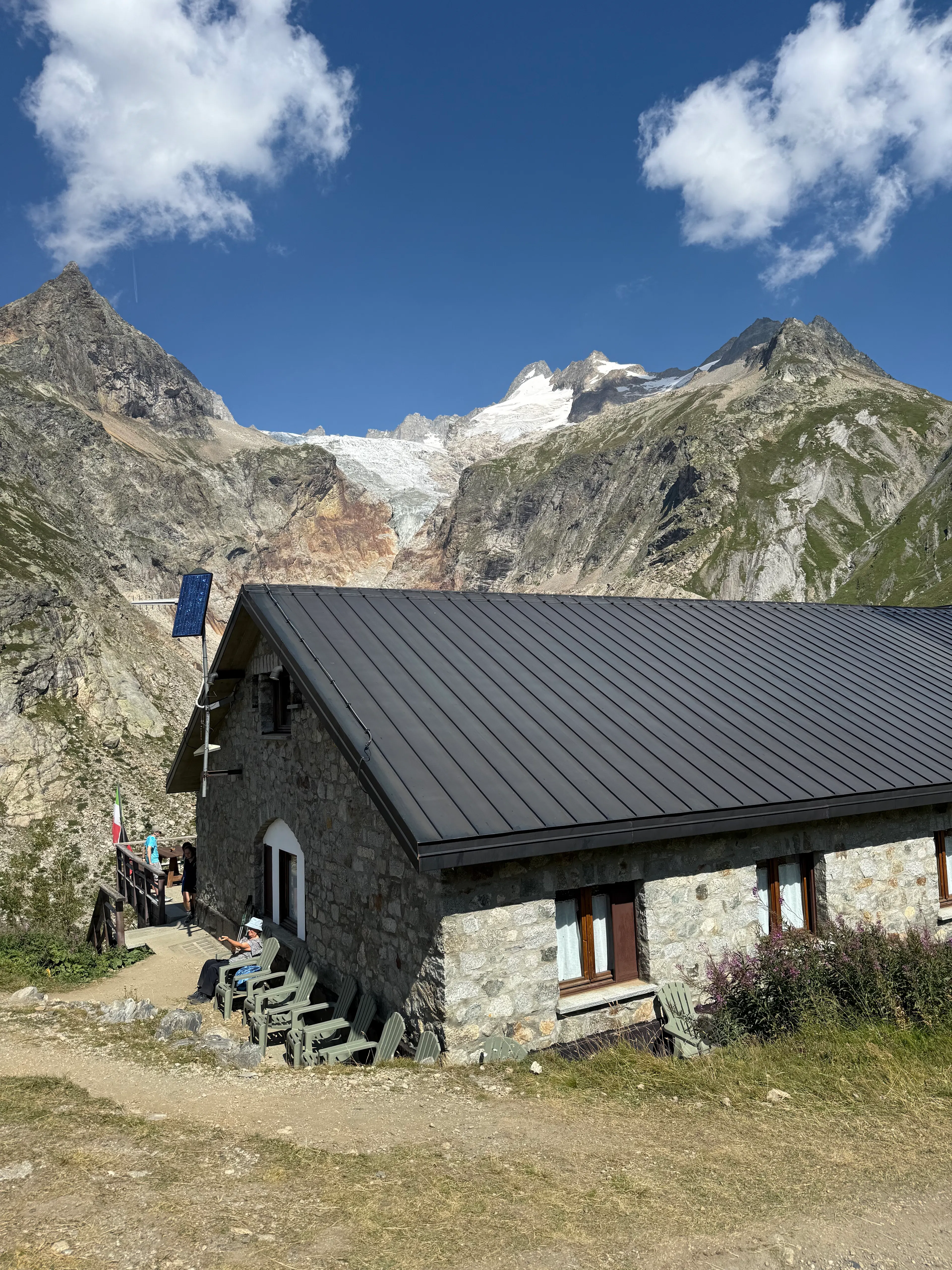
After breakfast in Verbier — and a last look at the Grand Combin from the terrace — our private transfer carries us across the Val de Bagnes to Champex-Lac (1,466 m), the small, elegant resort curled around its still alpine lake. This is where today's walking begins, and it begins with a decision.
This is a day of choices — and the guide makes the call in the morning, based on the group and the conditions. It's exactly the kind of decision that having a professional who knows this massif intimately is for.
The high option: Fenêtre d'Arpette (2,665 m). If the weather is settled and the group is moving well, we take the wildest crossing of the entire Tour du Mont Blanc — and its highest point. From Champex, the trail climbs the length of the Val d'Arpette, a beautiful, increasingly rugged valley that narrows to a final steep pull through boulder fields to the notch of the Fenêtre. The pass is a true mountain doorway, barely wider than the trail itself — and what waits on the other side stops every walker mid-stride: the Trient Glacier pouring down the far wall of the valley, its crevasses and séracs in full view as you descend directly opposite it for the better part of two hours. It's a demanding day of real alpine character, and one of the most memorable on the whole circuit.
The classic option: Bovine and the Col de la Forclaz. If conditions favour a gentler stage, we follow the traditional route across the alpage of Bovine — a beautiful high traverse through forest and open pasture, where cattle graze the slopes in summer and the view suddenly opens over the entire Rhône Valley, two thousand metres below, with its patchwork of vineyards and orchards stretching toward the distant Bernese Alps. The trail then eases over the Col de la Forclaz and down toward Trient.
Both routes converge on the quiet village of Trient, instantly recognisable by its little pink church against the dark forested hillside — the classic end point of this stage, and where we return tomorrow morning to continue the circuit.
But tonight, we've built something better into the itinerary. Rather than staying in tiny Trient, a private transfer whisks us down to Martigny, the historic town at the elbow of the Rhône Valley, for the most distinctive night of the trek: a 4-star hotel with its own Roman baths. Martigny was the Roman city of Octodurus two thousand years ago — its amphitheatre still stands at the edge of town — and tonight you recover the way the Romans did: drifting between warm pools, steam and cool plunges, letting the day's 1,400 metres dissolve. It's a deliberate piece of design. This is one of the biggest days of the tour, and an evening in the baths followed by an excellent dinner and a deep valley sleep resets the body completely for the French half of the journey.
Fenêtre d'Arpette option: Ascent +1,400 m | Descent −1,400 m | Walking time approx. 7 hours Bovine option: Ascent +800 m | Descent −1,000 m | Walking time approx. 5.5 hours Morning transfer Verbier–Champex and evening transfer Trient–Martigny included | Night in Martigny (4-star hotel with Roman baths) | Meals: breakfast, packed lunch, dinner
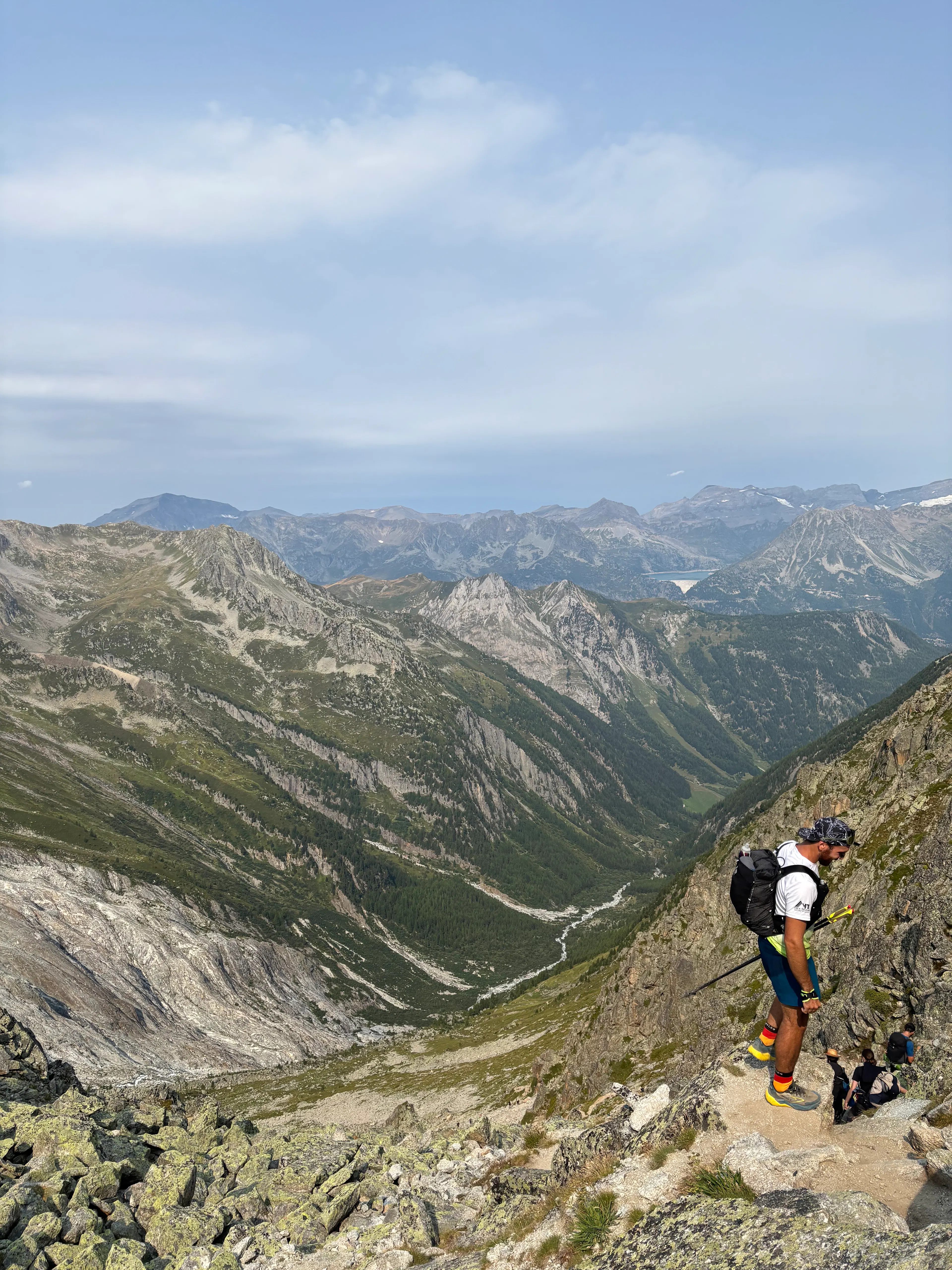
After breakfast in Martigny — and, for the disciplined, one last look at the spa — our private transfer carries us back up to Trient, dropping us at the little pink church exactly where we left the trail yesterday. Not a metre of the circuit is skipped; the comfort of the valley night costs nothing in walking terms.
The day's climb begins straight away, rising steadily out of the Trient valley through forest and old alpages toward the frontier ridge. This is a historic crossing — smugglers, shepherds and travellers have moved between Switzerland and France over the Col de Balme for centuries — and the trail has the settled, well-worn feel of a route that has always been walked.
Then comes one of the defining moments of the entire Tour du Mont Blanc. As you make the final steps to the Col de Balme (2,191 m), the border stone underfoot, the whole Chamonix valley suddenly unrolls ahead of you — and there, filling the head of it, is Mont Blanc itself, back in full view for the first time in days. The great white dome, the Aiguille Verte, the sharp granite of the Chardonnet and the Aiguilles de Chamonix: the entire massif lined up along the horizon like a curtain rising. Walkers tend to go quiet at this col. It's that kind of view, and it deserves a long pause — the packed lunch rarely has a better setting than this.
The descent into France is a pleasure: down across the open slopes above Le Tour, the highest village in the Chamonix valley, then along gentle balcony paths and through forest past Montroc. The glaciers grow steadily closer as you lose height, until the trail delivers you into Argentière (1,252 m) — a village with genuine mountain soul. Long a favourite base for alpinists and skiers, it sits directly beneath the tumbling icefall of the Argentière Glacier, and its old centre of stone-and-timber houses, climbing shops and unpretentious cafés still feels like a mountaineering village first and a resort second.
Tonight we sleep in Argentière — our first French evening of the tour, with the cuisine to match, and the hotel's sauna and steam room waiting to ease the Col de Balme out of your legs before dinner.
Ascent: +900 m | Descent: −1,000 m | Distance: approx. 15 km | Walking time: approx. 6 hours | Morning transfer Martigny–Trient included | Night in Argentière (3–4 star hotel) | Meals: breakfast, packed lunch, dinner
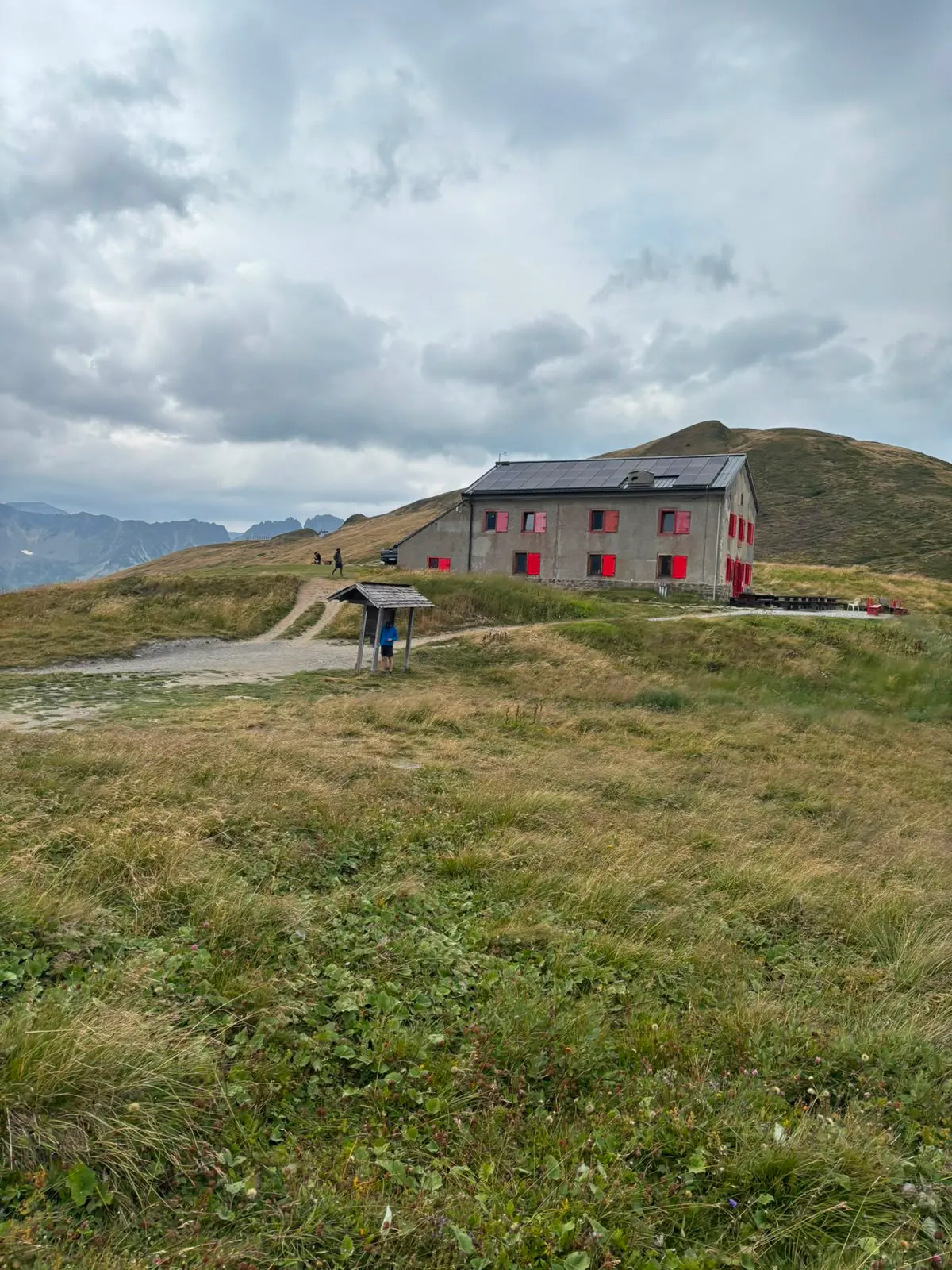
Ask walkers at the end of the tour to name their favourite day, and this is the one that comes up most often. Today we cross to the sunny side of the valley and walk the famous balcony of the Aiguilles Rouges — a full day face to face with the entire Mont Blanc massif, and the perfect final act of the traverse.
From Argentière, the trail climbs steadily into the Aiguilles Rouges nature reserve, a protected wilderness of red-tinged granite, dwarf pine and small tarns that occupies the whole northern wall of the Chamonix valley. The reserve exists for good reason: this is some of the richest wildlife habitat in the French Alps, and encounters are part of the day. Ibex are frequently seen posing on the rocks with complete indifference to their audience, chamois move across the slopes above, and the whistle of marmots follows you along the trail all morning.
But it's the view that defines this stage. The balcony path — the Grand Balcon Sud — runs at around 2,000 metres directly opposite the massif, and for hour after hour the greatest mountain wall in western Europe scrolls past across the valley: the Argentière Glacier, the fierce north face of the Aiguille Verte and the Drus, the Mer de Glace curving down between the Aiguilles, and finally the summit dome of Mont Blanc itself presiding over everything. There is nowhere better to grasp the sheer scale of what you've walked across this week — the massif seen not in glimpses, but as a single, continuous panorama, from a trail that feels like a farewell lap of honour. The pace today is deliberately unhurried; this is a day for long photo stops and an even longer lunch on a warm slab of granite with the best view in the Alps.
In the afternoon we reach La Flégère, where we board the cable car for the descent to the valley floor — a knee-sparing choice we make deliberately, trading a steep, unremarkable forest descent for extra time on the balcony above. Minutes later you step out in Chamonix, the world capital of mountaineering, where the statue of Balmat points de Saussure toward the summit of Mont Blanc — and where your traverse officially ends: three countries crossed, the finest trails of the TMB walked, from one alpine capital to the other. There's time for a celebratory drink on a café terrace beneath the Aiguilles before the last leg of the journey.
Then our private transfer carries us back through the Mont Blanc tunnel to Courmayeur — a fifty-minute ride that passes directly beneath the mountain you've spent the week walking around, and delivers you to the other side of the massif and the place where it all began. Tonight's home is a superb 4-star hotel in the heart of the village, and the evening rises to the occasion: the farewell celebration dinner, beneath the brick vaults of one of Courmayeur's oldest restaurants — a Michelin Guide-selected address in the historic centre, with refined Valdostan cooking, an excellent cellar, and a long table of people who have just crossed the Alps together. It began with a pizza; it ends beneath century-old vaults, back where you started — with the whole massif walked across in between.
Ascent: +900 m | Descent: −1,000 m (cable car descent from La Flégère) | Walking time: approx. 6 hours | Private transfer Chamonix–Courmayeur included | Night in Courmayeur (4-star hotel) | Meals: breakfast, packed lunch, farewell celebration dinner
After a week of passes, borders and balcony trails, the final morning of the tour is deliberately unhurried. A relaxed breakfast, no boots to lace, and time for a last coffee in the sunshine of Courmayeur's car-free centre — the same streets you walked through on your first evening, though they tend to look a little different once you've crossed the Alps to earn them back.
For those heading home, the shared private transfer to Geneva airport departs at 9:30 and is included in the price of the trip. As on arrival, if your travel plans don't fit the group schedule, we can arrange a private transfer at any time for an additional cost — just let us know when you book.
But there's no rule that says the journey has to end at breakfast. Courmayeur is a wonderful place to linger, and if you'd like to extend your stay and treat yourself to one last alpine experience, two ideas come warmly recommended by our guides:
Skyway Monte Bianco. Ride one of the most spectacular cable cars in the world from Courmayeur to Punta Helbronner at 3,466 metres, in rotating panoramic cabins that lift you from the valley floor into the heart of the glacier world in minutes. From the summit terrace you stand among the granite spires, séracs and hanging ice of the massif whose finest trails you have just walked — Mont Blanc close enough to read the texture of its snow, and your route traceable in the valleys below, from the Val Ferret all the way round to Chamonix. There is no better way to see, in a single sweep, exactly what you've achieved.
The Pré-Saint-Didier thermal spa. A few minutes from Courmayeur, the QC Terme thermal baths are among the finest in the Alps: outdoor thermal pools facing the Mont Blanc massif, saunas, steam rooms and relaxation spaces built around waters used for recovery since the 1800s. After a week on the trail, an afternoon drifting between warm pools — with the mountains you just crossed filling the horizon — is, in our experience, the perfect final chapter.
Both are easy to arrange independently, and we're happy to advise on timings, an extra hotel night in Courmayeur, or a later transfer if you decide to stay on.
However you choose to end it, the achievement travels home with you: three countries, the great passes of the Ferret and the Balme, the balconies of the Val Ferret and the Aiguilles Rouges — the finest days of the Tour du Mont Blanc, walked from Courmayeur to Chamonix entirely on foot.
Shared transfer to Geneva airport at 9:30 (included) | Private transfer available on request | Meals: breakfast
The Tour du Mont Blanc is a trek, not a climb — there is no glacier travel, no technical terrain, and no need for mountaineering experience. But it would be a mistake to underestimate it. This is a sustained, multi-day mountain journey: five consecutive days of walking, around 75 km in total, with some 4,500–5,000 metres of cumulative ascent and several passes above 2,100 metres. The single most important ingredient for enjoying it is arriving fit.
Cardiovascular fitness and endurance. You should be comfortable walking 5–7 hours per day, on consecutive days, with daily elevation gains of 600–1,300 metres. The key word is consecutive: plenty of hikers can manage one big mountain day, but the TMB asks for five in a row. The Champex–Trient stage, if the group takes the Fenêtre d'Arpette variant, is the biggest of the tour at around 7 hours and 1,300 metres of ascent. Our itinerary is designed to manage this, with gentler stages, cable cars that remove dead climbing, and comfortable hotel nights that maximise recovery — but the underlying fitness has to be yours.
Mountain walking experience. You should have previous experience of full-day hikes in mountainous terrain and feel confident on steep, rocky and occasionally rough paths. The TMB is well-marked and well-trodden, but it includes sustained descents on uneven ground, sections of loose stone, and — early in the season — the possibility of old snow patches on the high passes, where your guide will choose the safest line.
Daypack only. Thanks to the daily luggage transfers, you carry only a light daypack of around 5kg: waterproofs, warm layer, packed lunch, water and personal items. This makes an enormous difference to how the days feel, and it's one of the reasons this hotel-to-hotel format suits strong hikers who want to enjoy the trek rather than endure it.
How to prepare. We recommend starting structured training 10–12 weeks before departure: regular hill walking with a daypack (ideally back-to-back days at weekends), plus two or three weekly sessions of sustained cardio — trail running, cycling, swimming or brisk uphill walking. Leg and core strength work pays off most on the long descents, which surprise more TMB walkers than the climbs do. If you can comfortably complete two consecutive days of 6-hour hikes with 1,000 m of ascent, you're ready.
If you're unsure whether your fitness or experience is sufficient, contact us before booking. We're happy to talk through your background honestly and help you decide — and, if needed, point you toward a sensible training plan.
It's a 7-day hotel-to-hotel program covering the finest half of the Tour du Mont Blanc: a guided traverse from Courmayeur to Chamonix through Italy, Switzerland and France, following the most celebrated sections of the classic circuit, with an included transfer back to Courmayeur for the farewell evening. You sleep in hand-picked 3–4 star hotels every night, carry only a daypack, and everything from Geneva airport transfers to packed lunches and dinners is included. The program is led throughout by an IFMGA Mountain Guide or qualified International Mountain Leader.
No — and deliberately so. The full circuit takes ten days to walk properly; squeezing it into a week would mean long, rushed days and skipped sections. This tour instead follows the finest half of the route, from Courmayeur to Chamonix: the Val Ferret balcony beneath the Grandes Jorasses, the Grand Col Ferret border crossing, the Swiss valleys, the Col de Balme and the grand balcony of the Aiguilles Rouges. If you have eleven days, our full Tour du Mont Blanc Deluxe walks the complete circuit — this program is for those who want the best of the TMB in a single week.
It's a demanding but non-technical trek. Expect 5–7 hours of walking per day on consecutive days, with daily ascents of up to 900 metres on well-marked mountain trails — and up to 1,400 metres if the group takes the Fenêtre d'Arpette variant on the Champex–Trient stage. There's no glacier travel and no climbing, but good fitness and previous mountain hiking experience are essential. See the Requirements section above for full details and training advice.
The easiest way is to fly to Geneva. Our shared transfer departs Geneva airport at 15:00 on arrival day and brings you directly to Courmayeur (approx. 2 hours); the return transfer leaves Courmayeur at 9:30 on the final morning, in comfortable time for afternoon flights. Both are included. If your flight times don't fit the shared schedule, we can arrange a private transfer for an additional cost.
If you prefer to fly into another airport — such as Milan Malpensa or Turin — that's no problem either: we can organise a private transfer to Courmayeur for you at an additional cost. Just let us know your arrival details and we'll take care of it.
Hand-picked properties with genuine alpine character, chosen to match each stage of the traverse. In the towns — Courmayeur, Verbier and Martigny — you sleep in 4-star spa hotels, including the Roman baths night in Martigny, placed deliberately after the biggest walking day of the trek. On the trail itself, a characterful 3-star in Argentière — the historic mountaineering village of the Chamonix valley — keeps you close to the mountains, with its own sauna and steam room. Rooms are double or twin with private bathrooms; single rooms at an extra cost, subject to availability.
We deliberately keep groups small — 10 guests per departure. Small groups move well on the trail, fit comfortably into the characterful hotels we use, and mean your guide genuinely knows every walker's pace and condition by the end of the first day. And on any departure of more than six walkers, you're looked after by two guides rather than one — so even a fuller group keeps that same close, personal attention, with the flexibility to move at more than one pace when the trail calls for it.
You bring one main bag (soft duffel, max. 15 kg) which travels ahead by road every morning and is waiting at your next hotel's reception when you arrive. On the trail you carry only a light daypack with waterproofs, a warm layer, your packed lunch and water — around 5–7 kg.
Everything is included: breakfast at the hotel, a freshly prepared packed lunch each trekking day, and dinner every evening — starting with the welcome pizza in Courmayeur and ending with the farewell celebration dinner after closing the loop. One of the quiet pleasures of the TMB is eating your way across three countries: polenta and fontina in the Aosta valleys, rösti in the Valais, Savoyard cooking in France. Please tell us about any dietary requirements or allergies when you book, and we'll arrange everything with the hotels in advance.
Yes. Quality trekking boots and poles can be rented from our partner shop in Courmayeur — reserve them when you book and they'll be ready for collection on Day 1, during the afternoon before the briefing. One honest piece of advice from our guides: if you rent boots, wear them around town on Day 1 and let your guide know on the easier early stages so any fit issues surface immediately. Better still, if you own well broken-in boots, bring them — a week is a long time in unfamiliar footwear.
Mountain weather is part of the mountains, and this is where local guiding earns its keep. Your guide checks conditions every morning and adapts: choosing between route variants (such as the Fenêtre d'Arpette or Bovine on Day 4), adjusting start times ahead of afternoon storms, or using lower alternatives when a pass is unreasonable. The TMB is rich in options, and our guides know all of them. Full days lost to weather are rare; a well-managed change of plan is simply part of the craft.
Yes, it's mandatory. You must have travel insurance covering mountain rescue, helicopter evacuation and repatriation for trekking at altitudes up to 2,700 metres, valid in Italy, Switzerland and France. We strongly recommend adding cancellation cover as well.
Absolutely, and many of our guests do. Solo travellers are paired in a twin room with another guest of the same sex, or you can book a single room at an extra cost, subject to availability. TMB groups have a way of becoming close over a week of shared passes and long dinners — arriving alone rarely means finishing that way.
Our departures run from mid June to mid September, each beginning on a Sunday (Day 1), with the first walking day on Monday. Late June and early July offer wildflowers at their peak and lingering snow patches on the high passes, which adds a touch of alpine character; July and August bring the most settled weather and the longest days; September offers quieter trails, crisp air and the first autumn colours.
Yes, we recommend it. With only twelve small-group departures in 2027 and hotels along the route booked many months ahead, the popular dates fill early — our 2026 season sold out entirely. A deposit secures your place and, during the early bird window, locks in the discounted rate.
We ask for a 30% deposit at the time of booking, which secures your place on your chosen departure. Each departure is confirmed once it reaches the minimum group size of 4 participants — at that point we'll contact you and the outstanding balance becomes due.
Once the balance is paid and the departure is confirmed, the booking becomes non-refundable. We work this way for a simple reason: a confirmed departure means every guest can book flights well in advance, when prices are at their best. For this reason we strongly advise taking out cancellation insurance at the time of booking.
In the rare case that a departure doesn't reach the minimum of 4 participants, we'll contact you well in advance and offer you the choice of:
From 4.150€ ・ 17 Dates
5 (7 Reviews)